Japanese Glass Teaware: What to Look For and What to Buy
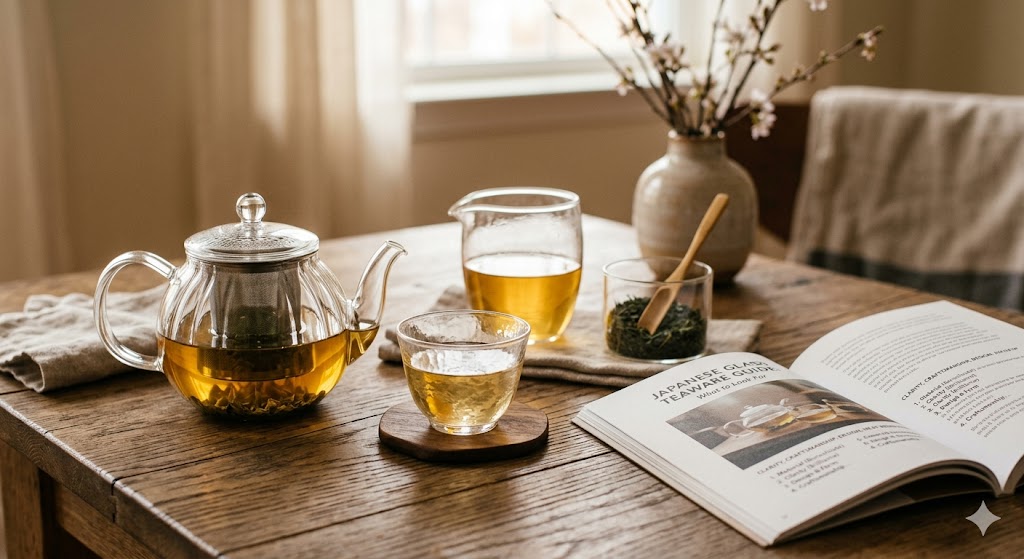
Japanese glass teaware occupies a particular niche in the kitchen: it has the functionality of Western glass (visible, easy to clean, no flavor absorption) combined with Japanese design sensibility — clean lines, modest scale, designed for the rituals of loose leaf
The Case for Glass Teaware
Traditional Japanese teaware is ceramic — Tokoname iron-rich clay, Bizen stoneware, delicate Arita porcelain. Glass is a relative newcomer to the Japanese
- Visual transparency: You watch the
tea ‘s color develop as it steeps. The amber of hojicha, the jade of kabusecha, the golden-green of genmaicha — all visible in real time. This isn’t just aesthetic; it’s informative. You can judge steep completion by color. - Flavor neutrality: Glass absorbs nothing. Unlike heavily porous clay teapots that can develop a seasoning over years, Japanese clay teapots such as Tokoname have low porosity and do not easily season — making them versatile for use with different teas. Glass, however, offers a completely neutral surface that tastes identical with every
tea you put in it. - Ease of cleaning: Glass stains from tannins and can be cleaned completely with mild acid (citric acid, vinegar) or alkali (baking soda). No lingering flavor from previous teas.
- Dishwasher-compatible: Most glass teaware, unlike clay kyusu, can go in the dishwasher when convenience is the priority.
What to Look for When Buying Japanese Glass Teaware
Borosilicate vs. soda-lime glass: The most important material distinction. Borosilicate glass (used by Hario and quality Japanese makers) has much higher thermal shock resistance — it handles the rapid temperature changes of
Wall thickness and uniformity: Quality Japanese glass teaware has consistent wall thickness throughout. Thin spots are weak points prone to cracking. Hold the piece up to light — inconsistent thickness shows as light/dark variation in the glass. Quality borosilicate is uniform and dense-looking.
Strainer quality: Glass teapots and kyusu include either a mesh strainer or a glass strainer. Metal mesh strainers (stainless steel, typically) are durable but can accumulate
Handle design: Heat-resistant handles in glass teaware are typically polypropylene, silicone, or glass. All work functionally. Glass handles are more elegant but require better manufacturing precision to avoid stress points. Heat resistance should be verified — the handle should never get uncomfortably hot when filled with boiling water.
Seal quality on lid: The lid should sit securely enough to prevent spilling when pouring but not so tight that removing it mid-steep is difficult. Check for lid fit before purchasing.
The Main Japanese Glass Teaware Brands
Hario: The dominant brand in Japanese glass teaware outside Japan. Established 1921, originally making laboratory glassware — the same material quality carries through to their kitchenware. Wide range of teapots, servers, cold brew bottles, and cups. The benchmark brand for most buyers. Shop our Hario teaware selection here.
Kinto: More design-forward than Hario — Kinto’s glass teaware tends toward contemporary minimalism. Quality borosilicate glass, thoughtful brewing systems (the UNITEA series is particularly refined). Slightly higher price point than Hario.
Tealyra and similar importers: Various brands that source from Japanese and Korean glassware manufacturers. Quality varies; check specific product reviews rather than brand reputation.
Key Pieces to Build a Glass Teaware Collection
Start with a teapot (kyusu or standard): The foundation. Choose based on brewing style — kyusu side-handle if you want the traditional Japanese brewing motion; conventional rear-handle if that’s more natural for you. 100–150ml for solo brewing; 200–300ml for two to three people; 400–450ml for multiple cups or sharing.
Add a glass server (optional but useful): Hario’s glass servers let you pour the entire teapot into a serving vessel to stop the steep — then distribute into cups from the server. Useful for genmaicha and sencha where precise steep time matters.
Add glass yunomi or teacups: Small glass cups (150–200ml) complete the set. Hario makes matched cups in various designs. The transparency of glass cups shows off
Consider a cold brew bottle: If you drink cold brew Japanese
Caring for Japanese Glass Teaware
- Hand wash is gentler than dishwasher over the long term, though most borosilicate is dishwasher-safe
- Avoid sudden temperature extremes — don’t pour ice water into a teapot that held boiling water
- Weekly baking soda soak prevents tannin buildup
- Monthly citric acid or vinegar treatment removes mineral deposits
- Store with lids off or ajar to allow complete drying — trapped moisture promotes bacterial growth and odor
Frequently Asked Questions
Is glass better than ceramic for Japanese
Can Japanese glass teapots go on an induction cooktop? Generally no — borosilicate glass is not compatible with induction and most glass teapots cannot be used on any burner. Use glass teapots only with water heated separately in a kettle.
What size glass teapot should I start with? 400–450ml is the most versatile starter size — appropriate for one person brewing solo or two people sharing. Large enough to be practical, small enough to brew intentional portions.
How do I remove scratches from glass teaware? Surface scratches in borosilicate glass cannot be removed — they’re permanent. This is why avoiding abrasive cleaners is important from day one. A scratched glass surface also stains faster because the rough surface gives tannins more to bind to.
Is Hario actually made in Japan? Hario is a Japanese company. Product manufacturing location varies — some products are made in Japan, others in China. Check individual product specifications if Japanese manufacture is important to you.