When most people think of Japanese tea, they picture green tea — sencha, matcha, gyokuro. The image of Japan as a green tea country is accurate but incomplete. Japan has been producing black tea since the Meiji era, when the government sent researchers to India and China to learn oxidized tea production to compete in export markets. That early commercial effort eventually faded, but the knowledge survived, and today a growing community of Japanese tea farmers is producing black tea of remarkable quality.
Wakocha (和紅茶) — literally “Japanese black tea” — is having a quiet renaissance. I have been following it for several years, and the best examples I have tasted rival Darjeeling first flush in their elegance and complexity, while tasting completely Japanese in character. If you love tea and have never explored wakocha, you are missing one of the most interesting corners of the tea world.
Key Takeaways- Wakocha is fully oxidized Japanese black tea made from Japanese Camellia sinensis cultivars
- Most wakocha is produced in small batches by specialty farmers — it is not mass-market tea
- Japanese cultivars (especially Yabukita) create a distinctly lighter, more floral black tea than South Asian varieties
- Key producing regions: Shizuoka, Miyazaki, Kumamoto, Kagoshima, Kyoto (Wazuka)
- Wakocha is typically best without milk — its delicacy is part of its character
What Makes Wakocha Different from Other Black Teas
All black tea is fully oxidized Camellia sinensis. The difference between Indian Assam, Chinese Keemun, Sri Lankan Ceylon, and Japanese wakocha comes primarily from cultivar, terroir, and processing method.
Japanese tea cultivars — particularly the widely planted Yabukita variety, which accounts for roughly 75 percent of Japanese tea plantings — were developed specifically for green tea production. Their chemical profile is optimized for minimal oxidation: high in theanine, moderately catechin-rich, prone to fresh, grassy flavors when processed as green tea. When these cultivars are fully oxidized into black tea, something interesting happens. The theanine and other amino acids that would contribute umami to a gyokuro instead become flavor precursors during oxidation, contributing floral, fruity, and honey-like notes that South Asian cultivars (bred for robust, tannin-heavy tea) do not typically produce.
The result is a black tea that is lighter in body and lower in tannins than Assam or Ceylon, often with floral or fruity notes (rose, peach, strawberry, and citrus are common descriptors), and a sweetness that comes through even without sugar. Wakocha is often compared to Darjeeling first flush rather than muscular Assam — delicate, complex, and best appreciated without milk.
History: The Long Journey of Japanese Black Tea
Japan’s black tea history is more complex than most people realize. In the 1870s, during the Meiji era modernization drive, the Japanese government dispatched officials to India (then under British colonial management) and China to study black tea production with the explicit goal of developing an export product to earn foreign currency. Production began in several prefectures, and Japanese black tea was exported to England and the United States in modest quantities through the late 19th and early 20th centuries.
The commercial ambition never matched India or Ceylon’s scale, and Japanese black tea production largely declined as the country doubled down on its domestic green tea culture. It persisted in pockets — particularly in Shizuoka and parts of Kyushu — but remained a minor curiosity for most of the 20th century.
The current revival began in the early 2000s, driven by a generation of artisan tea farmers interested in exploring their plants’ full potential, and an increasingly sophisticated domestic Japanese tea market willing to pay for specialty products. Today, wakocha is experiencing genuine growth — specialty tea shops in Tokyo, Kyoto, and Fukuoka now carry curated selections, and international specialty tea buyers are beginning to take notice.
Wakocha Producing Regions
Several Japanese prefectures produce noteworthy wakocha, each with its own character:
Shizuoka: The largest tea producing prefecture overall, with a long wakocha history. Shizuoka wakocha tends toward a clean, balanced profile — mild tannins, floral notes, accessible for daily drinking. Good entry-level wakocha often comes from here.
Miyazaki: One of the most exciting emerging regions for wakocha. Miyazaki’s warm climate and fertile soil produce black teas with particularly pronounced fruity and floral notes. Some Miyazaki wakocha has won major Japanese tea competitions in recent years. Smaller-scale artisan producers across Kumamoto and other Kyushu prefectures are doing similarly interesting work, experimenting with cultivars and oxidation levels in limited-production batches usually sold only through specialty importers.
Kagoshima: Known primarily for its green teas but producing some interesting wakocha from the Benifuuki cultivar, a variety developed partly for black tea production, which gives more muscatel and floral notes than standard Yabukita.
Wazuka, Kyoto: The birthplace of Japanese tea and best known for high-end green teas. Small-batch wakocha from Wazuka producers carries the Uji cultivar character — often delicate, sweet, and complex.
Cultivar Matters: Benifuuki and Beyond
While Yabukita dominates Japanese tea planting, specialized cultivars designed specifically for black tea production are gaining ground in wakocha. The most significant is Benifuuki (紅富貴), a cultivar developed by the National Institute of Vegetable and Tea Science through crossing a Darjeeling cultivar with a high-quality Japanese variety. Benifuuki produces a black tea with deeper color, more pronounced tannins, and distinctive rose and muscat grape notes.
Other cultivars used in specialty wakocha include Kōshun (紅峻) and Kirari 31, both developed with black tea production in mind. When you see these cultivar names on a wakocha product, it signals intentional black tea production rather than repurposing green tea plants — often a mark of higher quality and more deliberate processing.
How Wakocha Is Processed
The basic steps of black tea production apply to wakocha: withering, rolling, oxidation, and drying. But Japanese producers often adapt these steps in ways that reflect their green tea background and the characteristics of Japanese cultivars.
Withering in Japanese black tea tends to be longer than typical, allowing moisture to drop significantly before rolling. This concentrates sugars and aromatic precursors. The oxidation step is conducted carefully at lower temperatures than industrial Assam production, slowing the process to develop finer, more nuanced oxidation products. Some producers use CTC (cut-tear-curl) machinery for consistent smaller leaf, while artisan producers prefer orthodox whole-leaf processing.
The drying step in Japanese wakocha often uses techniques borrowed from green tea — careful temperature control to preserve delicate aromatics. The result is typically a black tea with lower astringency and higher fragrance than equivalent-grade Indian black teas.
How to Brew Wakocha
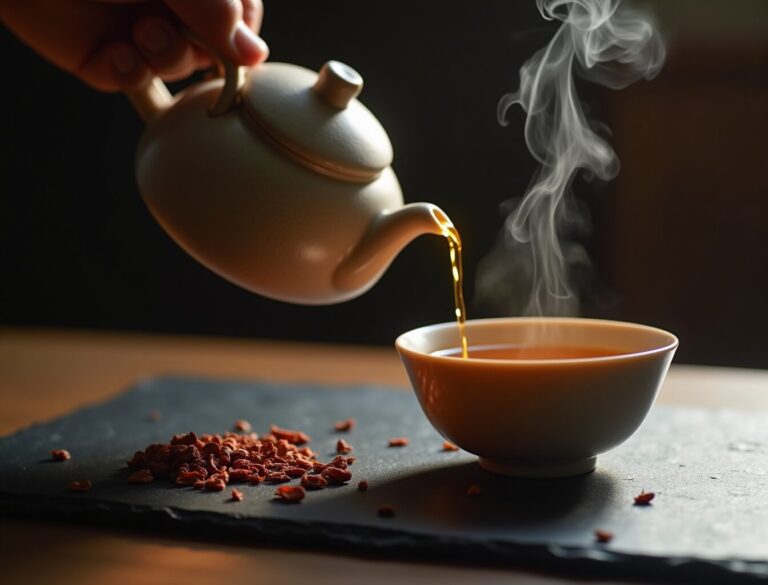
Wakocha is forgiving to brew but rewards attention. Use water that has just come off the boil — 90 to 95°C is ideal. Like most fine black teas, boiling water (100°C) can produce slight harshness with higher-quality, more delicate wakocha. Use approximately 3g per 150–200ml. Steep 2 to 3 minutes depending on desired strength.
Wakocha is best drunk without milk. The delicate floral and fruity notes are easily overwhelmed by dairy. Honey can be a pleasant addition if you prefer a sweet cup, though the natural sweetness of quality wakocha often makes even this unnecessary.
Iced wakocha is excellent — cold brewing (10g per 500ml, cold water, refrigerator, 6–12 hours) produces a particularly clean and refreshing cup with preserved aromatic notes.
Wakocha and Food Pairing
The lighter body and floral-fruity profile of wakocha makes it an excellent companion for foods that would be overwhelmed by a bold Assam. Consider:
- Japanese wagashi (traditional sweets) — the tea‘s subtle sweetness echoes and contrasts with bean paste confections
- Light fruit tarts and pastries where floral notes echo the tea
- Mild cheeses — brie, mild chèvre, cream cheese
- Japanese breakfast foods: rice, pickles, light fish dishes
- With chocolate: single-origin milk chocolate or white chocolate works better than dark
Wakocha vs Other Black Teas
- Vs. Darjeeling first flush: The closest comparison — similar delicacy and floral character — but wakocha still carries a Japanese green-tea DNA even through full oxidation
- Vs. Assam: Very different. Assam is malty and robust, built for milk. Wakocha is delicate and best drunk plain
- Vs. Ceylon: Ceylon runs more robust and citrusy; wakocha is softer and more floral
- Vs. oolong: Different oxidation level, though a few wakocha producers make semi-oxidized teas that bridge toward oolong character
Frequently Asked Questions
Is wakocha the same as Japanese black tea sold as “Wako”?
Wakocha is the general category; specific products may be branded with farm or region names. “Wako” is not a standard product name. When shopping for Japanese black tea, look for the term wakocha (sometimes written 和紅茶) or descriptions indicating Japanese-cultivar black tea, fully oxidized, from Japanese farms.
Why is wakocha so much more expensive than regular black tea?
Most wakocha is produced in small batches by artisan farmers, not at the industrial scale of Assam or Ceylon production. Japanese labor costs are high, cultivars optimized for black tea are still being established, and total production volume is modest. You are paying for small-batch craft production, similar to artisan coffee roasters versus commodity grocery store coffee.
Does wakocha have less caffeine than Indian black tea?
Approximately similar. Caffeine content in black tea is heavily influenced by the tea cultivar used, with Indian varieties naturally containing more caffeine than Japanese varieties. Leaf position (younger leaves have more caffeine) and processing, not cultivar. Wakocha made from first-flush leaves will have similar caffeine to a Darjeeling first flush — roughly moderate by black tea standards. It will generally have less caffeine than an Assam made from more mature leaves with a CTC process, but this is due to the inherent properties of the Japanese (Sinensis) cultivars used, which naturally contain lower caffeine levels than Indian (Assamica) varieties.
Where can I buy quality wakocha outside Japan?
Quality wakocha is available through Japanese specialty tea importers, some high-end tea shops, and online retailers specializing in Japanese food products. The market is still developing internationally — it is easier to find than five years ago but not yet mainstream. Look for products that specify cultivar (Benifuuki, Yabukita, Kōshun), region, and processing method. We carry a curated selection at shop.alldayieat.com.
Is wakocha the same as hojicha?
No — they go through completely different processing. Hojicha is green tea, unoxidized, that’s roasted afterward. Wakocha is green tea that’s fully oxidized before drying, making it a true black tea. The flavor difference is significant: hojicha is toasty and low in tannin, wakocha is floral, fruity, and structured like a black tea.
Where can I taste wakocha if I’m visiting Japan?
Specialty tea shops in major Japanese cities increasingly carry wakocha, and the producing regions themselves — Shizuoka, Kyoto, and Kagoshima — have farms that sell directly. Some of the best wakocha experiences are at small producer tasting rooms out in tea country rather than city shops.