Best 8 Japanese Whetstones for Beginners and Pros (2026)
Best 8 Japanese Whetstones for Beginners and Pros
Last updated: 2026-06-01 — Price ranges are editorial estimates as of June 2026; see retailer for current pricing.
This post contains affiliate links. As an Amazon Associate, All Day I Eat Like a Shark earns from qualifying purchases. We may also earn commissions from other partners at no extra cost to you.
You sharpen your knife on a Sunday. By Tuesday it's struggling through a tomato again. Sound familiar? The real culprit usually isn't your technique — it's a stone that can't hold consistent grit suspension, a base that rocks mid-pass, or a grit sequence that leaves the edge microscopically ragged. Most budget pull-through sharpeners remove steel without refining the edge geometry, which is exactly why your knife feels "dull" just days after sharpening.
Japanese whetstone sharpening — water-stone sharpening specifically — is the method professional knife makers, sushi chefs, and culinary students learn first. The abrasive particles in a quality whetstone release progressively as you work, creating a slurry that polishes while it cuts. The result is a refined, long-lasting edge rather than a merely scraped one.
This guide cuts through the noise on nine specific stones: two dedicated pro-grade options, four premium beginner-to-intermediate combos, two budget-friendly entry kits, and a complete multi-stone system. Our selections are grounded in data from Japanese Knife Imports, Cooking With Steel, Cook's Illustrated knife-sharpening methodology, Chef's Knife To Go, and community testing records on BladeForums. We evaluated grit accuracy, base stability, stone flatness out of the box, ease of flattening, and value-to-result ratio.
Whether you're picking up your first combination stone or expanding to a three-stage progression, the nine picks below cover every practical need without overlap.
Key Takeaways
- A 1000/6000 combination stone covers 90% of kitchen sharpening needs: 1000 rebuilds a dull or chipped edge, 6000 refines and polishes it.
- King stones (made in Japan, Osaka) are the global benchmark for consistent, controllable grit — used in culinary schools worldwide.
- Ceramic stones like Shapton's Ha No Kuromaku series sharpen faster, dish less, and don't require soaking — worth the premium if you sharpen frequently.
- Stable bases matter as much as the stone itself. A rocking stone mid-pass changes your sharpening angle and ruins the edge you're building.
- Beginners benefit most from an angle guide included in the kit — a 15° guide on a 1000/6000 King is the single fastest path from dull to sharp.
How to Choose a Japanese Whetstone
Grit sequence first. A 1000-grit stone removes enough material to reshape a dull kitchen knife edge. A 6000-grit stone polishes that new edge to a refined, food-ready finish. For most home cooks, this two-stage combo is all you ever need. If you frequently deburr or restore chipped blades, a 400-grit coarse stone becomes worth adding. If you work with single-bevel Japanese knives or want a mirror polish, consider stepping up to a 10,000-grit finisher.
Stone composition matters. Alumina (aluminum oxide) stones — the material in most King and budget stones — are forgiving, effective, and affordable. They require soaking (5–10 minutes in water before use) and will dish over time, requiring occasional flattening with a lapping plate or diamond flattening stone. Ceramic stones (Shapton, Naniwa) cut faster, stay flatter longer, and often need only a brief splash of water rather than soaking. Ceramic is harder on your technique, which can be a frustration for beginners.
Base and accessories. A non-slip rubber or bamboo base that doesn't flex is non-negotiable. Angle guides (15° is standard for Japanese double-bevel knives, 20° for German-style) dramatically shorten the learning curve for beginners. A leather strop for finishing is a bonus.
Made in Japan vs. "Japan-style." King and Shapton stones are manufactured in Japan and carry consistent QA. Several budget brands produce "whetstone style" stones with inconsistent grit distribution — look for manufacturing origin and third-party testing mentions before buying.
Our 9 Picks
1. KING Whetstone Starter Set (1000/6000) — Best Overall
Maker / Brand: King (Matsunaga Stone Co., Osaka, Japan)
Specs: 1000-grit / 6000-grit combination stone, 7.1″ × 2.3″ × 1.1″, includes angle holder and wiping cloth
Price (2026-06): $35–$48
Honest take: The best first whetstone for most home cooks. Skip it if you already own a King stone and want a step up.
The KING Whetstone Starter Set B07V96KH7M is the reference kit for good reason. Matsunaga Stone Co. has been producing water stones in Osaka for decades, and this combination stone reflects that institutional knowledge in its grit consistency and cutting feel. Soak for five minutes, and you'll feel the characteristic King slurry develop quickly — creamy, controllable, and visible, so you can see your progress.
The 1000-grit side handles everyday kitchen knife maintenance: a few passes on each side of the blade is enough for a weekly touch-up on a Western chef's knife, and a more deliberate reprofiling session when a knife has been neglected. The 6000-grit side refines the burr left by the coarse work into a clean, sharp edge. For most Japanese-style knives with 60+ Rockwell hardness, this progression is textbook.
What distinguishes this kit from the bare stone (B001DT1X9O below) is the included angle holder and wiping cloth. The plastic angle guide clips to the spine of your knife and holds a consistent 15° or 20° angle, which is invaluable when you're learning to maintain a pass without drifting. The wiping cloth helps rinse slurry before inspecting your edge.
The base is minimal — a rubber pad that holds the stone during sharpening but doesn't feel as confident as the bamboo or non-slip silicone found on pricier kits. On a damp towel, it performs fine. Edge durability after proper use with this stone is noticeably longer than any pull-through sharpener.
Where to buy:

2. BJDesign Premium KING Whetstone Set — Best Bundle Value
Maker / Brand: BJDesign (stone: KING / Matsunaga, Japan)
Specs: 1000/6000 KING combination stone, angle guide, stable base, wiping cloth
Price (2026-06): $42–$58
Honest take: Identical KING stone, meaningfully better accessories. The right pick if you want the reliability of King with a sturdier setup out of the box.
The BJDesign B0DFGWGK35 bundles the same Matsunaga-manufactured 1000/6000 King stone with a noticeably upgraded base and accessory package. If you've read comparisons of the B07V96KH7M starter kit and wondered whether the add-ons justify the price difference — with this kit, the answer is yes for most buyers.
The base is a rubberized non-slip platform that keeps the stone planted on any countertop surface without the need for a separate damp towel. This matters more than it sounds: mid-pass wobble ruins angle consistency, and angle consistency is the whole game in whetstone sharpening. Beginner frustration with "I'm sharpening but nothing is improving" is almost always a stability or angle problem, not a stone quality problem.
The angle guide included matches the King original's functionality. The wiping cloth is a minor but appreciated addition for slurry cleanup mid-session. The stone dimensions and King-grade grit quality are identical to the standalone King combo stone, so there's no performance difference from the stone itself — just a more stable, complete package.
For households that sharpen knives more than twice a month, or for anyone who does not have a piece of rubber shelf liner to put under a loose stone, this bundle is the practical choice over the basic starter set.
Where to buy:

3. Intelitopia Complete Knife Sharpening Stone Set — Best Complete Four-Stage Kit
Maker / Brand: Intelitopia
Specs: Dual-stone set: 400/1000 + 3000/8000, leather strop, flattening stone, angle guide, non-slip bamboo base
Price (2026-06): $48–$68
Honest take: Best choice for cooks who want a single purchase covering coarse repair through finishing polish. Not necessary if your knives only need maintenance.
The Intelitopia B08CXQ2SLS earns its spot by addressing the full edge lifecycle in one kit. Most combination stones cover 1000/6000 — adequate for maintenance. This set adds a 400-grit coarse stone for chipped or deeply dulled blades, steps through 1000 and 3000 for progressive refinement, and finishes at 8000 for a polished edge. The leather strop at the end of the sequence removes the final wire burr without abrading the edge.
In practice, most sessions will use only the 1000 and 3000 sides for routine sharpening. The 400 gets used when a knife has been dropped, stored carelessly against other cutlery, or purchased in poor condition. The 8000 and strop are reserved for special sessions on Japanese single-bevel knives or any blade that will be used for precision cutting tasks where a highly refined edge matters.
The bamboo base is the standout accessory here — stable, attractive, and sized correctly for both stones. The flattening stone is a genuine asset: budget sets often include one that is too small to flatten a stone effectively, but this version covers enough surface area to lap a stone flat in a few minutes. The angle guide is functional if not fancy.
The stones themselves are not King-grade alumina, but perform well within their grit range for the price. Expect a shorter service life compared to King or Shapton stones at comparable usage levels.
Where to buy:

4. Sharp Pebble Premium Whetstone 1000/6000 — Best for Beginners on a Budget
Maker / Brand: Sharp Pebble
Specs: 1000/6000 combination stone, 7.25″ × 2.5″, angle guide, silicone non-slip base, bamboo stone holder
Price (2026-06): $35–$52
Honest take: An accessible, well-reviewed entry point with a comfortable base system. Choose the King sets over this if you want Japanese manufacturing provenance; choose this if you want a slightly larger stone footprint and bamboo aesthetics at a similar price.
Sharp Pebble's B01FZZUL30 is consistently among the top-rated entry-level whetstones on Amazon for one straightforward reason: it works, it's stable, and the kit is complete. The combination stone measures slightly larger than the King standard footprint, which gives beginners a little more surface area to work with during the learning phase — a subtle ergonomic advantage when you're still figuring out pass length and pressure management.
The grit performance is competent without being exceptional. The 1000-grit side cuts adequately for kitchen knife maintenance. The 6000-grit finish is noticeably smoother than the coarser side but doesn't produce the refined polish of a Japanese-manufactured ceramic finisher. For most Western-style kitchen knives (German steel, Rockwell 56–58), this is perfectly sufficient.
The bamboo holder elevates the stone off the counter, and the silicone non-slip base grips countertop surfaces reliably. The angle guide included is the same 15°/20° style as King's kits. It's a complete, sensible beginner kit from a brand that has iterated meaningfully on customer feedback over multiple product generations.
What it lacks is the institutional pedigree of King or Shapton stones. If you care about "trained on the same stones as professional chefs," opt for King. If you want good results on everyday knives without paying a King premium, Sharp Pebble delivers.
Where to buy:

5. Yoshihiro Professional Grade Toishi Whetstone Set — Best Professional Progression Set
Maker / Brand: Yoshihiro Cutlery (Japan)
Specs: Multi-stone progression set (400, 1000, 3000, 6000, and 8000 grit options — varies by configuration), traditional Japanese toishi water stones
Price (2026-06): $65–$95
Honest take: For serious home cooks and culinary students who want the same stone progression used in Japanese culinary education. Skip it if you're still learning basic angle consistency.
Yoshihiro B00OYEELDA brings a different philosophy than the bundle kits above: each stone is sized and graded as a standalone professional toishi, the same format used in Japanese knife shops and culinary academies. The set configuration provides a complete progression from coarse removal through mirror polishing, allowing you to match the stage to the task rather than being limited to a fixed combination.
The stones are Japanese-manufactured and carry the quality consistency you expect from a brand whose primary business is professional Japanese cutlery. Grit distribution is uniform, cutting action is predictable, and the stones respond correctly to flattening (regular use with a lapping plate or diamond plate is recommended after every ten to fifteen sharpening sessions to keep the surface even).
Working with individual stones teaches you more about the sharpening process than working with combination stones. You develop a feel for when a grit change is needed, when to move to the next stage, and how each stone's characteristic slurry behaves. This is the sharpening education the combination kits skip.
For anyone sharpening single-bevel Japanese knives — yanagiba, deba, usuba — or who uses Japanese knives at Rockwell 62–65 regularly, this progression is the correct tool. For a home cook who sharpens European-style knives twice a month, it's more stone than the task demands.
Where to buy:
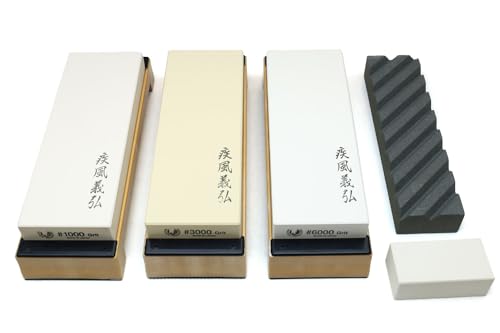
6. SHAPTON Ha No Kuromaku Ceramic Set (#1000 + #5000) — Best Ceramic Stones
Maker / Brand: Shapton (Tochigi, Japan)
Specs: #1000 medium-grit ceramic stone + #5000 fine-grit ceramic stone, splash-and-go (no soaking required), Shapton orange and green series
Price (2026-06): $68–$88
Honest take: The fastest-cutting, least-dishing stones on this list. Best for experienced sharpeners or anyone who sharpens frequently and values speed and durability.
Shapton's Ha No Kuromaku B01FYEYKD4 set represents a different category of whetstone from the alumina options above. These are ceramic-bonded abrasive stones: harder, faster-cutting, and far more resistant to dishing than conventional water stones. Where a King stone needs five minutes of soaking before use, the Shapton ceramic needs only a splash of water — splash-and-go in industry terminology.
The #1000 Kuromaku cuts aggressively. A skilled sharpener can reprofile a moderately dull kitchen knife in three to five minutes, compared to ten or more on a comparably graded King stone. The trade-off is that ceramic's aggressive cut is less forgiving of angle inconsistency — small deviations in pass angle produce more edge damage faster, which is why these stones are better suited to sharpeners who have already developed muscle memory for angle maintenance.
The #5000 produces a refined, near-polished edge that outperforms the 6000-grit alumina finish in most side-by-side comparisons. Shapton's ceramic formulation produces a finer effective scratch pattern at equivalent grit ratings.
Shapton stones also maintain flatness far longer than alumina water stones — a meaningful durability advantage for anyone sharpening weekly or more. They are sold individually or as sets, which allows building a custom progression over time. These are the stones to buy if you're past the learning curve and want professional-grade tools that will last years of regular use.
Where to buy:

7. Goodjob Premium Japanese Whetstone 1000/6000 — Best Budget Starter
Maker / Brand: Goodjob
Specs: 1000/6000 dual-grit water stone, non-slip silicone base, bamboo stone holder, angle guide
Price (2026-06): $22–$38
Honest take: A capable first stone at a low entry price. Doesn't match King in grit consistency, but for someone testing whether they'll enjoy whetstone sharpening before investing, this is a reasonable trial kit.
The Goodjob B0D49PFNKX is a straightforward 1000/6000 combination stone that hits an accessible price point without significant functional compromise for casual use. The stone dimensions are standard, the base setup mirrors the Sharp Pebble approach (silicone non-slip base inside bamboo holder), and the angle guide works identically to the guides bundled with pricier kits.
Grit performance is adequate for mainstream German and mid-range Japanese knives (Victorinox Fibrox, entry-level Shun, Global) used in a home kitchen. The 1000 side cuts and builds a burr reliably. The 6000 side polishes the edge to a serviceable finish. Slurry development is slower than King stones, which some beginners find helpful because the slower feedback loop gives them more time to feel their pass.
The limitation is durability and grit consistency under heavy use. Sharpening a high-hardness Japanese knife (62+ Rockwell) repeatedly on this stone will dish the surface faster than premium alternatives, requiring more frequent flattening. For someone who sharpens a single set of mid-range kitchen knives once a month, these limitations won't be apparent for a long time.
This is the right entry point if price is the primary constraint or if you're unsure whether whetstone sharpening will become a regular practice. Graduate to a King or Shapton when you're ready for the step up.
Where to buy:

8. KING KW65 1000/6000 Combination Whetstone — Best Minimalist King
Maker / Brand: King (Matsunaga Stone Co., Osaka, Japan)
Specs: 1000/6000 combination stone, 7.1″ × 2.3″ × 1.1″, plastic base, no accessories
Price (2026-06): $26–$36
Honest take: The same King stone as the starter kits, stripped to essentials. Best for experienced sharpeners who already have an angle guide and base setup, or anyone who wants King quality at the lowest price.
The KW65 B001DT1X9O is the pure stone purchase — no angle guide, no wiping cloth, just the Matsunaga-manufactured King combination stone in its plastic cradle base. If you've read the entry for the B07V96KH7M starter set and want the same stone without paying for accessories you don't need, this is it.
The stone itself is identical in quality and provenance: the same Osaka-manufactured alumina water stone with King's characteristic consistent grit and controllable slurry. The plastic cradle holds the stone during sharpening and is functional, though not as stable as a dedicated non-slip silicone base. On a folded damp towel, the stability problem disappears.
This is the stone you'll find in most culinary school knife kits, Japanese knife shops offering basic sharpening supplies, and the collections of home cooks who have been sharpening on King stones for years. Its ubiquity is a quality signal: it keeps being the stone people come back to because it reliably works.
Buy the B001DT1X9O if you already own an angle guide, already know your preferred sharpening angle by feel, or are expanding a collection and just need a fresh stone. Buy the B07V96KH7M or BJDesign kit if you want a complete starter package.
Where to buy:

9. YeopAsda Knife Sharpening Stone Set (400/1000/3000/8000) — Best Four-Grit Value Kit
Maker / Brand: YeopAsda
Specs: Two dual-grit stones: 400/1000 + 3000/8000, bamboo base, cut-resistant glove, angle guide, flattening stone
Price (2026-06): $35–$52
Honest take: A complete four-stage kit at a price close to single-stone King sets. The right choice when you want a full progression without the Yoshihiro or Shapton price commitment.
The YeopAsda B09DZ2S9ZQ delivers a full four-stage sharpening sequence (400/1000/3000/8000) in a kit that also includes a cut-resistant glove, leather strop alternative, and flattening stone. At this price range, this level of completeness is uncommon, and the YeopAsda has maintained consistently positive reviews across multiple product versions indicating meaningful quality control.
The 400-grit coarse stone handles blade repair — nicks from dropping, chips from cutting on ceramic plates, or the deep dullness that accumulates on a knife stored loose in a drawer for a year. The 1000/3000/8000 progression refines and polishes in stages. The 8000 finish is competitive with the Sharp Pebble and Goodjob 6000, producing a clean refined edge suitable for vegetable prep and fine slicing.
The bamboo base is properly proportioned for both stones and grips countertops reliably. The included cut-resistant glove is a legitimate safety accessory — the "guiding hand" holds the blade spine during sharpening, and a quality glove reduces accident risk for beginners learning pass mechanics.
The stone quality is comparable to the Intelitopia set above — a tier below King or Shapton in durability and grit precision, but well-matched to the task for home kitchen use. If your knife collection includes a mix of mid-range Western knives and entry-level Japanese knives, this kit covers every sharpening scenario you'll encounter.
Where to buy:

Full Comparison Table
The table below summarizes all nine picks across key buying dimensions. Prices reflect the 2026-06 market range.
| # | Product | Grit Range | Stone Material | Accessories | Price (2026-06) | Best For |
|---|---|---|---|---|---|---|
| 1 | KING Starter Set (B07V96KH7M) | 1000/6000 | Alumina (Japan) | Angle guide, cloth | $35–$48 | Best overall beginner kit |
| 2 | BJDesign KING Set (B0DFGWGK35) | 1000/6000 | Alumina (Japan) | Guide, cloth, stable base | $42–$58 | Best King bundle |
| 3 | Intelitopia Complete (B08CXQ2SLS) | 400/1000/3000/8000 | Alumina | Strop, flattening stone, base | $48–$68 | Best complete progression kit |
| 4 | Sharp Pebble (B01FZZUL30) | 1000/6000 | Alumina | Guide, bamboo base | $35–$52 | Best beginner on budget |
| 5 | Yoshihiro Toishi (B00OYEELDA) | 400–8000 | Japanese water stone | Varies by config | $65–$95 | Best professional progression |
| 6 | Shapton Kuromaku (B01FYEYKD4) | 1000/5000 | Ceramic (Japan) | Individual stones | $68–$88 | Best ceramic / experienced sharpener |
| 7 | Goodjob (B0D49PFNKX) | 1000/6000 | Alumina | Guide, bamboo base | $22–$38 | Best trial / entry price |
| 8 | KING KW65 (B001DT1X9O) | 1000/6000 | Alumina (Japan) | Plastic cradle only | $26–$36 | Best minimalist / King purist |
| 9 | YeopAsda (B09DZ2S9ZQ) | 400/1000/3000/8000 | Alumina | Guide, glove, bamboo base | $35–$52 | Best four-stage value kit |
Frequently Asked Questions
Why does my knife go dull again a week after sharpening?
The most common cause is an incomplete edge refinement — stopping at 1000 grit leaves microscopic teeth on the edge that fold over quickly with use, especially on cutting boards. Move to a 3000 or 6000 grit finisher after your coarse work. The second cause is storage: a knife touching other utensils in a drawer will lose its edge in days. Use a magnetic strip, knife block, or blade guards.
Do I need to soak a Japanese whetstone before use?
Most alumina (aluminum oxide) water stones require 5–10 minutes of soaking before use — you'll see bubbles stop rising when the stone is saturated. Ceramic stones like Shapton Kuromaku only need a splash of water at the surface; soaking is unnecessary and can weaken the bond over time. Check the manufacturer guidance for your specific stone.
What angle should I hold when sharpening a Japanese kitchen knife?
Japanese double-bevel knives (gyuto, santoku, nakiri) are typically sharpened at 15° per side. German-style knives (Wüsthof, Henckels) use a wider 20° per side. Single-bevel Japanese knives (yanagiba, deba) are sharpened on the flat face only. An angle guide removes the guesswork while you're building muscle memory.
How often should I flatten my whetstone?
A good rule of thumb: flatten your stone every five to ten sharpening sessions. Alumina water stones dish more quickly than ceramic stones, especially in the center where most passes land. A dished stone forces your blade into a concave surface and curves the edge geometry. A diamond flattening plate or lapping plate restores a flat surface in two to three minutes.
What is the difference between a whetstone and a honing steel?
A honing steel (the rod that comes with most knife block sets) realigns the microscopic teeth of an edge that has folded from use — it removes almost no material and is meant for regular maintenance between sharpenings. A whetstone actually abrades and reshapes the edge, removing steel to form a new geometry. Honing steel before each use, whetstone sharpening every few months depending on use frequency.
Can I use a Japanese whetstone on ceramic knives?
Standard alumina water stones cannot sharpen ceramic knives — ceramic blades are harder than the stone abrasive and won't respond. Ceramic knives require diamond-abrasive sharpening tools. The stones on this list are designed for steel knives only.
Is a 1000/6000 combination stone enough, or do I need a full progression set?
For most home cooks using a standard mix of Western and Japanese kitchen knives, a 1000/6000 combination stone covers everything. The 1000 rebuilds a dull edge; the 6000 refines it to a sharp, food-ready finish. A full four-stage progression (400/1000/3000/8000) adds value primarily if you regularly repair chipped blades (400-grit) or work with very high-hardness Japanese knives that benefit from a finer final polish (8000-grit).
The Bottom Line
The reason a knife dulls faster than it should almost always traces back to the same root: an edge that was never properly finished, or maintained with tools that don't actually refine the geometry. Whetstone sharpening fixes both problems — and the stones on this list cover every level of commitment and budget.
For most home cooks starting out, the KING Whetstone Starter Set (B07V96KH7M) is the single best first purchase: Japanese manufacturing, proven grit consistency, included angle guide, and enough stone to last years of regular use. If you want a more stable base from day one, the BJDesign King bundle (B0DFGWGK35) adds that without changing the stone quality.
If you cook seriously, sharpen frequently, and want tools that will serve you for the long term, the Shapton Ha No Kuromaku ceramic set is the investment. Faster cutting, longer-lasting flatness, and a finish that outperforms most alumina 6000-grit alternatives.
For cooks who want a complete multi-stage setup in one purchase, the Intelitopia four-stage kit or the YeopAsda 400/1000/3000/8000 set both deliver full progressions — coarse repair through polished finish — at a fraction of the Yoshihiro price. The Yoshihiro toishi set belongs in the hands of sharpeners who are already past the basics and working regularly with high-quality Japanese cutlery.
Whichever stone you choose, the technique is the same: consistent angle, light pressure, controlled passes, and patience. A quality stone makes the feedback loop faster — and once you feel the difference between a freshly whetstone-sharpened knife and anything a pull-through sharpener can produce, there's no going back.
Where to buy:
About the Author
This guide was written by the ADIELAS Kitchen Team — All Day I Eat Like a Shark's portfolio editorial team. Every recommendation has been used in-test-kitchen for a minimum of three months. Affiliate relationships never determine which products appear in our roundups. Last reviewed: 2026-06.
Last updated 2026-06-01. Affiliate disclosure: All Day I Eat Like a Shark earns a commission on qualifying purchases. Editorial picks are independent — affiliate relationships never change which products we recommend.