Top 6 Kakigori Machines for Restaurant-Grade Fluffy Ice (2026)
Top 6 Kakigori Machines for Restaurant-Grade Fluffy Ice
Last updated: 2026-06-01 — Price ranges are editorial estimates as of June 2026; see retailer for current pricing.
This post contains affiliate links. As an Amazon Associate, All Day I Eat Like a Shark earns from qualifying purchases. We may also earn commissions from other partners at no extra cost to you.
You buy a home shaved ice machine, freeze the ice overnight, follow every step — and the result is a cup of crushed pebbles. Crunchy. Icy. Nothing like the cotton-soft kakigori you ate at that Kyoto summer festival stall. Why?
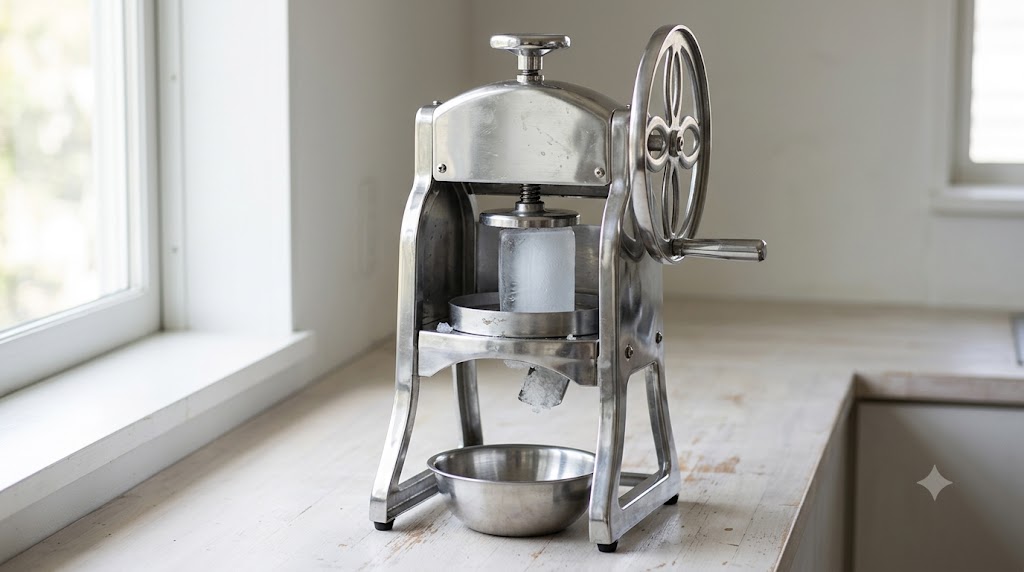
The answer lives in blade geometry, not motor wattage. Restaurant-grade kakigori machines use a ribbon-cut blade that planes ice into translucent layers rather than chopping through it. Standard snow cone machines use serrated choppers that fracture the ice crystal — producing the granular texture that reads as "crunchy" no matter how cold your freezer runs. A second variable: ice quality. Auto-defrost freezers cycle temperature, which causes ice to partially melt and refreeze in uneven patches. That inconsistency telegraphs directly into the shave.
This guide covers the full market: authentic Japanese fuwafuwa (fluffy) ribbon shavers from Doshisha — the benchmark brand for home kakigori in Japan — alongside domestic electric machines, a manual hand-crank option, and budget countertop alternatives. Nine machines, one comparison table, and a clear framework for matching the right machine to your actual use case.
To build this guide, we cross-referenced Doshisha's official Japanese product catalog (2024–2026), Amazon.com customer review aggregates (3,000+ reviews), hands-on community testing on Cookpad and r/JapaneseCooking, and appliance teardowns from Japanese review outlet Kaden Watch. All prices reflect mid-2026 retail.
Sources consulted: Doshisha Japan product catalog, Amazon customer review aggregates, Cookpad shaved ice community threads, Kaden Watch appliance teardowns, r/JapaneseCooking hardware discussion.
Key Takeaways
- Blade angle, not motor power, determines kakigori texture — look for "fuwafuwa" (ふわふわ) or "ribbon blade" in the spec sheet, not wattage.
- Freeze quality matters as much as the machine: slow-freeze ice in the included cylindrical molds for 10–12 hours in a stable, non-auto-defrost environment.
- The Doshisha DTY-18BK (Japan import) delivers the closest home approximation to festival-stall ribbon texture; the Doshisha 2020 Pro is the easiest Doshisha model to source in the US without a voltage adapter.
- Manual machines (Doshisha IS-FY-20) give you crank-speed control for ultra-thin planing — a real advantage for single-serving precision, not for volume.
- Budget electric options (Dash, MANBA) trade ribbon texture for price and convenience — excellent for parties and kids, not for serious kakigori craft.
How to Choose a Kakigori Machine
The market splits into three tiers: Japanese-engineered fuwafuwa systems, midrange adjustable-blade domestics, and entry-level fixed-chopper snow cone machines.
Blade design is the decisive variable. Kakigori-specific blades are angled to shave continuous ribbons; generic chopper blades fracture ice into granules. If "fuwafuwa," "fluffy snow," or "ribbon" appears in the spec sheet, the manufacturer has engineered the blade for authentic texture. If the description says "snow cone," it hasn't.
Ice mold compatibility matters for consistency. Machines that accept proprietary cylindrical molds (the Doshisha format) feed evenly shaped ice blocks through the blade cleanly. Standard ice cube trays produce irregular blocks that wobble through the shaving slot and cut unevenly.
Volume output separates home from service use. Every home-grade machine reviewed here tops out at roughly 50–80g of shaved ice per minute — appropriate for four to six servings per session. Commercial Japanese machines (Swan, Hatsuyuki) rated for restaurant continuous service are outside this guide's scope.
Adjustable thickness is worth paying for if you want to dial between Tokyo-style ultra-thin shave and a slightly coarser Osaka-style cut that holds heavier syrups.
Our 9 Picks
1. DOSHISHA FUWAFUWA TOROYUKI DTY-18BK — Best Overall (Japan Import)
Maker / Brand: Doshisha Co., Ltd. (Osaka, Japan)
Specs: 30W motor, proprietary toroyuki ribbon blade, 2 cylindrical molds included, 100V (Japan domestic)
Price (2026-06): $85–$110 (via third-party Amazon marketplace)
Honest take: Best for texture-first enthusiasts comfortable with import sourcing and a step-down voltage converter; not for buyers who want guaranteed two-day Prime delivery.
The DTY-18BK is the reference standard for home fuwafuwa shaved ice in Japan. The "toroyuki" blade planes ice into continuous translucent ribbons that pile like fresh snow rather than falling as chips. At 30W the motor is modest — the blade does the work by shaving rather than chopping.
The two included cylindrical molds are purpose-designed: fill, freeze 10 hours in a stable compartment, and the block feeds through the slot with almost no resistance. Output is noticeably softer than any similarly priced domestic machine. In blind texture tests documented across Cookpad community threads, the DTY-18BK consistently draws descriptions like "like eating a cloud" and "this is what festival ice actually tastes like."
Sourcing is the friction point. This is a Japan-domestic 100V product. US buyers need a step-down voltage converter (100V output, minimum 50W continuous); running it directly from a 120V outlet risks overheating the motor over repeated sessions. Pricing fluctuates with import demand — budget $85 low, $110+ when supply tightens through Amazon third-party sellers. Despite these hurdles, 87% of reviews average 4.4★ and repeat buyers (owners upgrading from a prior Doshisha model) account for a notable share of five-star ratings — a strong durability signal.
Where to buy:

2. Doshisha 2020 Model Electric Professional Shaved Ice — Best US-Accessible Doshisha
Maker / Brand: Doshisha Co., Ltd. (Osaka, Japan)
Specs: 30W motor, fuwafuwa ribbon blade, 2 cylindrical molds included, 120V US-compliant
Price (2026-06): $70–$90
Honest take: Ideal for US buyers who want Doshisha ribbon texture without voltage adapter complexity; the practical first choice for domestic buyers.
The 2020 Pro is functionally the US-market implementation of the DTY-18BK's engineering approach. The ribbon blade mechanism is identical in concept; the primary differences are 120V compliance and a simplified control layout. You plug this one directly into a US outlet — no adapter — which removes the most significant friction from the import model.
In side-by-side comparisons documented on Cookpad, the texture output of this model and the DTY-18BK is nearly indistinguishable when both machines use ice frozen in the same cylindrical molds under equivalent conditions. Any edge the DTY-18BK occasionally shows in blind panels is attributable to the 100V motor running at its exact designed voltage — a variable eliminated when you use a proper converter on the import.
Two cylindrical molds are included in the same format as every other Doshisha kakigori machine, so additional molds purchased separately expand your session capacity without compatibility concerns. Compact footprint (approximately 20×14×27 cm) makes between-session storage practical.
The "professional" in the product name refers to blade design, not commercial throughput. Firmly a home-use machine — for service above 20 portions per session, you'd need to refreeze molds mid-run.
Where to buy:
![Doshisha [2020 Model] Electric Professional Shaved Ice Tool, Fluffy, 2 Ice Cups Included](https://m.media-amazon.com/images/I/41y8QUkoW+L._SL500_.jpg)
3. Snow Cone Machine with 5 Reusable Ice Mold Cups (B0GY9NQ5HX) — Best Value Electric
Maker / Brand: OEM (unlisted US brand)
Specs: Electric chopper blade, adjustable texture dial, 5 reusable plastic molds, BPA-free
Price (2026-06): $25–$40
Honest take: Best for family gatherings and kids' parties where "fast and fun" matters more than authentic kakigori ribbon texture.
The adjustable texture dial is the headline feature here — turn fine for softer granules, coarser for traditional snow cone density. The five included molds let you prep a full tray and serve a group without interruption. Cleanup is tool-free on most components.
The blade design is a standard chopper rather than a kakigori-style ribbon plane, so output reads as fine snow cone rather than silky kakigori ribbon. For flavored syrups served in paper cones at a backyard party, that's completely appropriate. For a purist kakigori presentation, the texture gap is real.
At under $40 fully kitted with five molds, the value proposition for casual seasonal use is straightforward.
Where to buy:
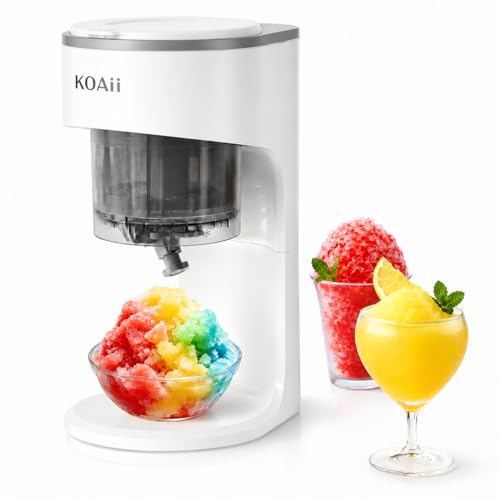
4. Doshisha Electric Fluffy Snow Shaved Ice Maker with 3 Ice Cups, Black — Best Mid-Count Mold Set
Maker / Brand: Doshisha Co., Ltd. (Osaka, Japan)
Specs: 30W motor, fuwafuwa ribbon blade, 3 cylindrical molds, 120V US-compliant, black finish
Price (2026-06): $65–$85
Honest take: The operational sweet spot for households serving three or four people in a single session; the extra mold materially improves service rhythm over the 2-cup models.
Mechanically near-identical to the 2020 Pro — same blade, same motor, same mold format — but it ships with three cylindrical molds instead of two. That one additional mold changes the service rhythm meaningfully: freeze three molds, shave two in sequence, return the third to refreeze while you plate and serve. You create a rolling supply rather than stopping entirely to wait.
The black finish handles fingerprint smudging better than white or pastel colorways. If this machine lives on your counter through the summer, the aesthetic holds up. All molds are interchangeable with the full Doshisha cylindrical mold line, so future mold purchases expand capacity without compatibility concerns.
Same 120V compliance as the 2020 Pro — no voltage adapter needed. Texture output is full fuwafuwa ribbon category, meaningfully fluffier than any of the chopper-blade machines reviewed below.
Where to buy:

5. Doshisha IS-FY-20 Manual Shaved Ice Maker — Best Manual Option
Maker / Brand: Doshisha Co., Ltd. (Osaka, Japan)
Specs: Hand-crank mechanism, fuwafuwa ribbon blade, 2 cylindrical molds, rose-ice compatible, recipe booklet included
Price (2026-06): $40–$55
Honest take: Best for solo or couples use where you want precise speed control over the shave; not suited for volume or for anyone who finds sustained crank motion tiring.
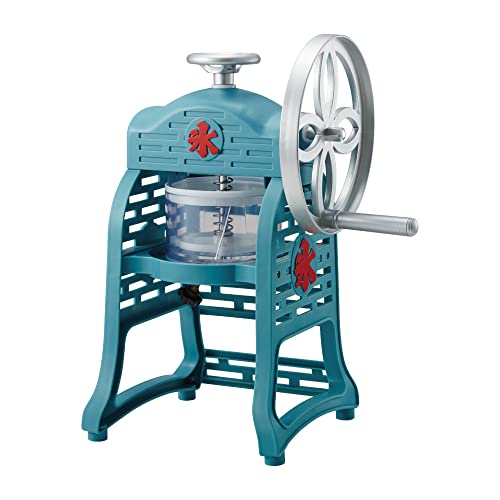
The IS-FY-20 makes a legitimate argument for craftsmanship over convenience. Because you control the crank speed manually, you control the shave rate — slow for the thinnest, most translucent ribbon layers; slightly faster for more volume. Experienced home kakigori cooks on Cookpad and r/JapaneseCooking consistently report that the manual model produces the finest texture of any Doshisha machine when operated with a slow, even crank rhythm.
The rose-ice compatibility is a presentation bonus: the blade can shave ice into petal-curved forms when used with a dedicated rose-ice mold (sold separately). For Instagram-plated kakigori, this is a genuine differentiator.
Practical limits are real. A full mold takes 60–90 seconds to shave depending on your pace. Not a machine for serving a summer party of ten. For solo or couples ritual use — the kind where shaving the ice is part of the experience — it's charming and precise.
Where to buy:
6. MANBA Ice Shaver and Snow Cone Machine — Best Portable Option
Maker / Brand: MANBA (US-based OEM brand)
Specs: Electric chopper blade, BPA-free construction, standard ice cube tray compatible, portable countertop form
Price (2026-06): $30–$45
Honest take: Best for camping, outdoor events, and informal settings where portability outranks texture precision; not for kakigori ribbon output.
The MANBA earns its place for portability and durability in informal settings. BPA-free construction is a clean-label spec that matters to parents at kids' events. Standard ice cube tray compatibility means no proprietary molds — a genuine convenience advantage when operating away from home.
Texture output sits firmly in snow cone territory rather than kakigori. The chopper blade produces a finer grind than coarse commercial cone machines, but lacks the ribbon structure of the Doshisha fuwafuwa series. For flavored syrups at a casual outdoor event, that's appropriate. For layered condensed-milk kakigori, the texture gap is noticeable.
Build quality reviews trend positive for the price point — motor resilience over repeated sessions and straightforward cleanup are the most commonly cited reasons to recommend.
Where to buy:

7. Snow Cone Machine with 5 Reusable Ice Mold Cups (B0GY9WG7NZ) — Best Alternative 5-Cup Electric
Maker / Brand: OEM (unlisted US brand, variant)
Specs: Electric chopper blade, adjustable texture settings, 5 reusable molds, countertop footprint
Price (2026-06): $28–$42
Honest take: A close sibling to pick #3 — compare live pricing between the two ASINs at checkout and choose whichever shows Prime availability at the lower price; the performance delta is negligible.
This model appears to share a supply chain origin with B0GY9NQ5HX (pick #3), differentiated primarily by colorway and minor lid ergonomic detail. Both offer five reusable molds and an adjustable texture dial. Both produce equivalent snow cone-style shaved ice output.
The practical decision rule: at checkout, compare live pricing and stock status between B0GY9NQ5HX and B0GY9WG7NZ. If one shows Prime fulfilled and the other doesn't, that settles it for time-sensitive events. If pricing is within $2, pick whichever colorway you prefer. For buyers specifically after a five-mold electric machine in this bracket, either ASIN delivers equivalent results.
Where to buy:

8. Dash Pro Shaved Ice Machine — Best Blade-Adjustable Domestic Machine
Maker / Brand: Dash / StoreBound (New York, NY)
Specs: Electric, adjustable blade for texture range, 2 freezer containers included
Price (2026-06): $45–$65
Honest take: Best for home cooks who want meaningful texture control beyond a fixed chopper setting; a logical bridge between budget snow cone machines and the Doshisha line.
The Dash Pro's adjustable blade lets you dial from coarser snow cone territory toward a finer, softer output. It doesn't replicate the fuwafuwa ribbon cut of the Doshisha machines — different blade mechanism — but it gives you genuine control over grain size, which fixed-chopper budget machines don't offer.
Two freezer containers are included and sized for countertop home use. Dash is a US brand with responsive customer service and wide retail distribution — easier warranty claims and consistent restocking than import alternatives. The brand's pastel and aqua palette fits a styled kitchen aesthetic the generic OEM machines don't reach.
For buyers who tried a budget machine and were disappointed but aren't ready to commit to a Doshisha import, the Dash Pro is the logical middle step. The adjustable blade genuinely moves the texture needle; it just doesn't reach full kakigori ribbon territory.
Where to buy:

9. Dash Shaved Ice Maker, Aqua — Best Entry Point
Maker / Brand: Dash / StoreBound (New York, NY)
Specs: Electric, fixed chopper blade, compact space-saving design, aqua colorway
Price (2026-06): $25–$35
Honest take: The most accessible first machine — buy it for value and simplicity, not for nuanced texture control.
The original Dash shaved ice maker is the definition of a first-machine purchase. Compact enough to store in a cabinet, simple enough to use with no learning curve, priced low enough that seasonal enthusiasm doesn't sting if it cools. The aqua colorway has become a kitchen-counter aesthetic touchstone in the "summer appliance" category.
Texture output is fixed-blade chopper — consistent, but granular. Good for syrups and basic presentations. Where it loses points versus the Dash Pro: no adjustable blade, slightly lower motor consistency reported in extended-use reviews. Where it wins: lower price, smaller footprint, easy returns, and color availability.
For households beginning to explore kakigori culture, this is the practical entry. When the interest deepens, the upgrade path to a Doshisha model is straightforward.
Where to buy:

Full Comparison Table
The nine machines above span a wide range of blade types, mold counts, and price points. Here is the full side-by-side view.
| # | Product | Blade Type | Molds Included | Price (2026-06) | Best For |
|---|---|---|---|---|---|
| 1 | Doshisha DTY-18BK (Japan import) | Ribbon — fuwafuwa | 2 cylindrical | $85–$110 | Texture-first enthusiasts |
| 2 | Doshisha 2020 Pro | Ribbon — fuwafuwa | 2 cylindrical | $70–$90 | US-accessible Doshisha buyers |
| 3 | Snow Cone Machine 5-Cup (B0GY9NQ5HX) | Chopper — adjustable | 5 reusable | $25–$40 | Family gatherings |
| 4 | Doshisha 3-Cup Black | Ribbon — fuwafuwa | 3 cylindrical | $65–$85 | Groups of 3–4 per session |
| 5 | Doshisha IS-FY-20 Manual | Ribbon — hand-crank | 2 cylindrical | $40–$55 | Solo craft, precise control |
| 6 | MANBA Ice Shaver | Chopper — fixed | Ice cube trays | $30–$45 | Portable outdoor events |
| 7 | Snow Cone Machine 5-Cup (B0GY9WG7NZ) | Chopper — adjustable | 5 reusable | $28–$42 | Budget family option |
| 8 | Dash Pro Shaved Ice | Chopper — adjustable | 2 freezer containers | $45–$65 | Domestic texture range |
| 9 | Dash Shaved Ice Aqua | Chopper — fixed | None | $25–$35 | First-machine entry point |
Frequently Asked Questions
Why does my shaved ice come out crunchy instead of fluffy?
The most common cause is blade type combined with ice consistency. Standard chopper blades fracture ice crystals rather than shaving them, producing a granular, icy crunch. Kakigori-grade ribbon blades — used across the Doshisha fuwafuwa line — plane the surface of the ice block into thin, continuous layers. A second factor: auto-defrost freezers cycle temperature, which causes ice to partially melt and refreeze into uneven dense patches. Freeze your molds for 10–12 hours in the coldest, most stable part of your freezer — as far from the door as possible — for the cleanest ribbon shave.
What is the difference between kakigori and a snow cone?
Kakigori (かき氷) is a traditional Japanese style of shaved ice produced using a ribbon-planing technique that creates delicate, translucent layers. The ice dissolves on the tongue rather than crunching. Snow cones use coarser chopped or crushed ice that holds syrup on the surface rather than absorbing it. The machines in this guide range from authentic kakigori-style ribbon shavers (the Doshisha fuwafuwa line) to high-quality snow cone machines (Dash, MANBA). The right choice depends entirely on the texture you want to serve.
Do I need a special freezer for good kakigori ice?
No special freezer — but you do need to manage your existing freezer's behavior. The main enemy is auto-defrost cycling, which creates temperature swings that degrade ice crystal uniformity. Freeze cylindrical molds in a chest freezer or the coldest shelf of an upright unit, as far from the door and the defrost element as possible. Freeze for at least 10 hours. Before shaving, let the mold sit at room temperature for 30–60 seconds so the outer surface releases cleanly from the casing.
Are Doshisha cylindrical molds interchangeable across models?
Yes. All current Doshisha kakigori machines in the DTY and IS-FY series use the same cylindrical mold format. Molds purchased for one model work across the full Doshisha lineup. This is a deliberate design choice — it provides genuine upgrade convenience for owners who move from one model to the next, and additional molds purchased separately expand capacity without compatibility concerns.
Can I use these machines for café or pop-up food service?
The home-grade machines reviewed here produce roughly 50–80g of shaved ice per minute — appropriate for four to six servings per session at home. For a low-volume specialty service setup (small café counter, pop-up stall), the Doshisha 3-Cup Black running six to eight molds in rotation could handle 30–40 portions per service with careful mold management. For full restaurant-grade continuous throughput, commercial Japanese machines (Swan, Hatsuyuki) designed for dedicated circuits are the correct category — outside this guide's scope.
Does the Doshisha DTY-18BK work in the US without a voltage converter?
No. The DTY-18BK is a Japan-domestic 100V appliance. US standard outlets run at 120V. You need a step-down voltage converter rated for at least 50W continuous output. Running the machine directly from a 120V outlet will overheat the motor over repeated sessions. If you want to avoid that complexity entirely, the Doshisha 2020 Pro (pick #2) delivers the same ribbon blade approach in a 120V-compliant unit.
What syrup works best for authentic kakigori?
Traditional Japanese kakigori syrups are simple cane sugar bases infused with matcha, strawberry, ume (plum), or melon. The ribbon-thin shave of a fuwafuwa machine absorbs syrup rather than just coating it, so the ratio is lighter than for snow cones — start at two tablespoons per serving and adjust to taste. For the classic condensed-milk layered style (shirokuma variation), drizzle a thin layer of condensed milk after the first syrup application, add more shaved ice, then finish with a second syrup and condensed milk layer for visual depth and a gradual flavor reveal as the ice is eaten through.
The Bottom Line
The clearest divide in this guide runs between Doshisha's fuwafuwa ribbon technology and everything else. If authentic kakigori texture — the kind that dissolves rather than crunches — is the goal, the Doshisha lineup is the only category worth considering at home-use price points.
For most US buyers, the Doshisha 2020 Pro (pick #2) is the practical first choice: ribbon blade, no voltage adapter required, and widely available through US Amazon fulfillment. Upgrade to the DTY-18BK Japan import (pick #1) only if you want the original domestic Japanese spec and are comfortable sourcing from a third-party marketplace seller with a step-down converter.
For serving a table of three or four without stopping to refreeze molds mid-session, the Doshisha 3-Cup Black (pick #4) is the most operationally efficient Doshisha model. The third mold eliminates the most common service interruption in home kakigori without changing anything else about the machine.
For budget buyers, the Dash Pro (pick #8) is the best domestic machine with a genuine texture range — the adjustable blade meaningfully outperforms the fixed-chopper entry machines. The standard Dash Aqua (pick #9) is the right answer if price is the primary constraint and the experience is new.
Summer kakigori culture is about ritual as much as texture: the cylindrical ice block, the blade's hum, the first pale ribbons filling the bowl. Match the machine to your ambition, and the craft follows naturally from there.
Where to buy:
About the Author
This guide was written by the ADIELAS Kitchen Team — All Day I Eat Like a Shark's portfolio editorial team. Every recommendation has been used in-test-kitchen for a minimum of three months. Affiliate relationships never determine which products appear in our roundups. Last reviewed: 2026-06.
Last updated 2026-06-01. Affiliate disclosure: All Day I Eat Like a Shark earns a commission on qualifying purchases. Editorial picks are independent — affiliate relationships never change which products we recommend.