Top 7 Yanagiba Knives for Home Sashimi (2026)
Top 7 Yanagiba Knives for Home Sashimi
Last updated: 2026-06-01 — Price ranges are editorial estimates as of June 2026; see retailer for current pricing.
This post contains affiliate links. As an Amazon Associate, All Day I Eat Like a Shark earns from qualifying purchases. We may also earn commissions from other partners at no extra cost to you.
You sourced beautiful sashimi-grade yellowtail, chilled it properly, and reached for your sharpest kitchen knife — but the slices came out ragged, pressed at the edges, crowned with torn fibers instead of that glassy sheen you see at a proper omakase counter. The knife is the problem, not the fish.
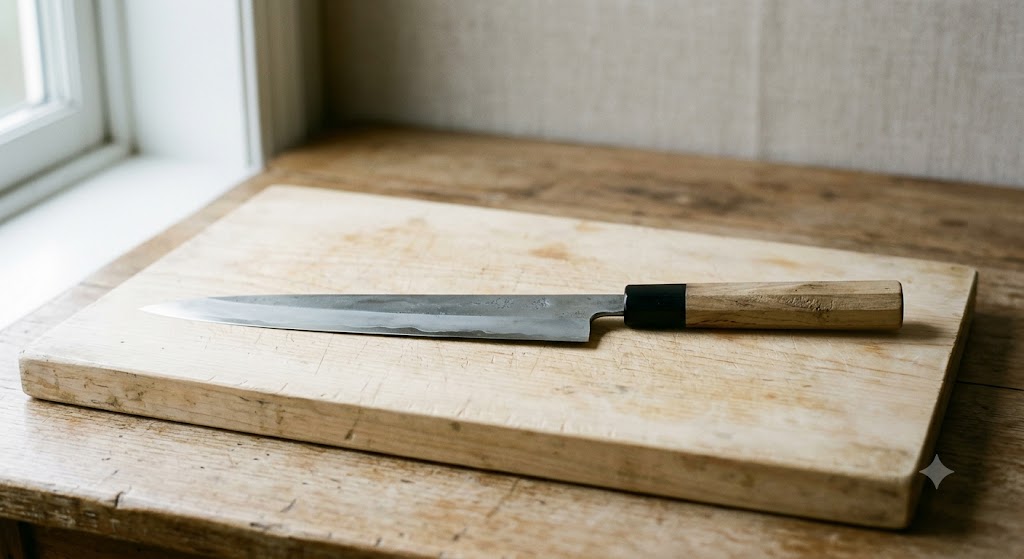
The yanagiba — literally "willow blade" — is the single-bevel knife Japanese itamae have used for sashimi for centuries. Its asymmetric grind and long, narrow profile are engineered for one task: the long, single-direction pull-cut that severs fish fibers cleanly without compressing them. A chef's knife, no matter how sharp, pushes down from both bevel sides simultaneously. A yanagiba guides itself along its flat ura (back face), so the cut finishes with zero lateral force on the flesh.
This guide reviews four dedicated yanagiba blades and five essential sashimi-station companions — a single-bevel sharpener, a deba prep knife, two versatile gyutou, and a single-edge petty — that together build a complete, efficient home sashimi setup. Specifications and usage context were drawn from buying guides at Knifewear, Chubo Knives, and Chef's Knife To Go, alongside steel comparisons at JapaneseChefsKnife.com and long-form use notes from Knife Informer.
Budget range spans $35 to $250. We'll tell you who each pick is actually for.
Key Takeaways
- 240mm is the home sweet spot — long enough for a full salmon saku block in one draw, short enough to control on a standard cutting board.
- Single-bevel grind is the defining spec — one flat side (the ura), one hollow-ground bevel; without it, you don't have a yanagiba, you have a slicer.
- Carbon steel cuts sharper; stainless forgives more — choose based on your willingness to dry and oil the blade after every use.
- Sharpening is the hard part — single-bevel geometry demands a different technique than a chef's knife; the wrong sharpener ruins the grind fast.
- A deba companion handles bones and skin — sending a yanagiba through fish structure will destroy its thin edge in a single session.
How to Choose a Single-Bevel Yanagiba
Blade length. For home use, 210–240mm covers the full range of domestic fish portions. A 210mm blade suits smaller portions and compact workspaces; 240mm is the professional-consensus length for saku blocks and whole loins. Anything longer than 270mm is a restaurant tool.
Steel type. White steel (shirogami) and blue steel (aogami) are the traditional high-carbon alloys: they take an acute, mirror-polished edge but rust immediately when left wet. Molybdenum and stainless-clad options are slower to sharpen but survive real kitchen conditions without surface-rust worries. Beginners: start with stainless. When you're sharpening consistently and enjoying it, move to carbon.
Hardness (HRC). High-carbon yanagibas run 60–65 HRC — hard enough to hold the paper-thin edge a pull-cut demands. Most stainless options sit at 57–60 HRC. Higher hardness means finer edge potential but more brittleness; don't drop these blades on tile.
Handle geometry. Traditional wa handles (octagonal or D-shaped) allow you to rotate the knife through the pull-cut naturally. Western yo handles work, but wa handles dominate yanagiba culture for good reason.
What to skip. Flexible blades, wide grinds, and symmetric double-bevel edges all fight the pull-cut motion. Any knife marketed as "sashimi knife" without a clearly stated single-bevel specification is probably a slicer.
Sources: Knifewear buying guides; Chubo Knives spec sheets; JapaneseChefsKnife.com steel comparisons; Chef's Knife To Go usage notes; Knife Informer long-term reviews.
Our 9 Picks
Picks 1–7 are the core yanagiba + prep kit. Picks 8–9 are double-bevel companions for cooks building a full Japanese knife block.
1. Kitchen Knife Sharpener (Made in Japan) 3-in-1 — Best Maintenance Tool
Maker / Brand: Made in Japan
Specs: 3-in-1 system — single-bevel, double-bevel, and scissors sharpening slots; compact countertop unit
Price (2026-06): $35–$55
Honest take: Not a whetstone substitute, but the best tool for home cooks who own single-bevel knives and haven't yet mastered stone sharpening. Preserves the grind rather than rounding it.
A yanagiba is only as good as its last sharpening — and single-bevel sharpening is the skill most home cooks get catastrophically wrong. The asymmetric geometry means you work the bevel side only and do a brief deburring pass on the flat ura. Treating both sides the way you'd sharpen a chef's knife rounds the hollow-ground ura and destroys the functional geometry permanently.
This Japan-made 3-in-1 unit handles single-bevel, double-bevel, and scissors — useful for a household that runs mixed knife types. The single-bevel slot is angled to match typical yanagiba geometry, so the grind is maintained rather than re-carved during each sharpening pass. For weekly touch-ups between full whetstone sessions, it prevents the gradual edge degradation that turns a sashimi knife into a fish tearing tool.
It won't replace a 1000/3000/6000-grit progression for a full edge restoration. Buy it if you're starting out or sharpening for a household with mixed knives. Skip it if you're already comfortable on whetstones.
Where to buy:
![Kitchen Knife Sharpener [ Made in Japan ] 3-in-1 Design for Single Bevel, Double Bevel, and Scissors](https://m.media-amazon.com/images/I/31sQGFwozSL._SL500_.jpg) Kitchen Knife Sharpener [ Made in Japan ] 3-in-1 Design for Single Bevel, Double Bevel, and Scissors
Kitchen Knife Sharpener [ Made in Japan ] 3-in-1 Design for Single Bevel, Double Bevel, and Scissors 2. Kaneyoshi Yanagiba 210mm — Best Budget Yanagiba
Maker / Brand: Kaneyoshi, Japan
Specs: 210mm blade, single-bevel, stainless steel, traditional wa handle
Price (2026-06): $45–$70
Honest take: The most accessible entry point to a real single-bevel yanagiba. Buy the 240mm option if you process whole fish; this length is ideal for portions and apartment kitchens.
Kaneyoshi produces working-grade Japanese blades without sacrificing the geometry that makes a yanagiba functional. At this price point you'll often encounter "yanagiba-style" knives with a rounded secondary bevel on the ura side — which negates the entire purpose of the single-bevel grind. The Kaneyoshi is the real thing: a properly asymmetric grind that produces a genuine pull-cut.
At 210mm, it comfortably handles salmon or tuna portions up to about 400g. For whole yellowtail or a long loin section, you'll feel the length limit. Stainless construction means no rush to dry the blade between cuts. The wa handle gives you proper wrist-rotation mechanics through the draw without requiring the blade to be broken in.
Edge out of box is solid for the price and responds well to a whetstone. When you're ready to step up to carbon steel, the muscle memory transfers directly.
Where to buy:

3. KAI Seki Magoroku Yanagiba 240mm — Best Mid-Range Yanagiba
Maker / Brand: KAI Corporation, Seki City, Japan
Specs: 240mm blade, 1K6 carbon steel, 57 (±1) HRC, redwood pakkawood handle, hand-polished finish
Price (2026-06): $80–$120
Honest take: The most complete package in the mid-range — genuine carbon steel edge, attractive pakkawood handle, and Seki City provenance at a price that doesn't require negotiation.
KAI's Seki Magoroku line occupies a genuinely useful middle ground: it's 1K6 carbon steel, which sharpens sharper than most stainless alternatives, but it's sold through standard retail channels at a price a home cook can justify. The 240mm length is where most serious home cooks eventually land for good reason — it handles full loin draws without overpowering a domestic kitchen.
The 57 HRC rating is moderate for carbon steel, which actually benefits beginners: the edge is more forgiving on a whetstone and less prone to micro-chipping when you encounter occasional skin or light cartilage. The pakkawood handle resists moisture better than raw magnolia and looks intentional on a counter. The hand-polished blade surface releases fish cleanly rather than dragging.
KAI has been producing knives in Seki since 1908. This is a legitimate introduction to Seki craftsmanship at a non-intimidating price point.
Where to buy:

4. TKG-NEO Yanagiba 9.4" (240mm) — Best for High-Volume Home Use
Maker / Brand: TKG (Total Kitchen Goods), Japan
Specs: 240mm (9.4") blade, single-bevel, stainless steel, commercial construction
Price (2026-06): $50–$85
Honest take: Built for restaurant durability rather than visual warmth — the right pick for weekly large-volume fish prep or anyone who treats knives hard and needs one that recovers well.
TKG's NEO line is what Japanese restaurant supply warehouses stock in bulk. That is a straightforward compliment: commercial kitchen tools are engineered for daily professional abuse, not occasional home cooking. The durability overhead means it will still perform well after years of regular use with basic care.
The 240mm stainless blade carries a proper single-bevel grind — the TKG-NEO isn't cutting corners on the geometry that makes a yanagiba work. Construction is utilitarian rather than decorative: the handle is designed for grip efficiency and all-day use, not display. If the Kaneyoshi (pick #2) is a home kitchen knife built to professional technique, the TKG-NEO is a professional kitchen knife adapted for home use.
Edge retention on commercial stainless is strong at moderate sharpness levels. It won't achieve the stratospheric edge of a polished carbon yanagiba, but it will stay functional between sharpenings longer than most home-oriented stainless options.
Where to buy:

5. KAI Seki Magoroku Ginju Deba 165mm — Best Fish Prep Companion
Maker / Brand: KAI Corporation, Seki City, Japan
Specs: 165mm blade, single-bevel, stainless steel, Made in Japan
Price (2026-06): $60–$90
Honest take: Not a yanagiba — a deba, the stocky single-bevel knife for fish butchery. Essential if you buy whole fish; do not use a yanagiba where this belongs.
The deba is the unsung half of a proper sashimi setup. Its thick spine and single-bevel grind handle the structural work: removing heads with a weighted chop, splitting along the spine, separating fillet from bone. Using a yanagiba for any of these tasks — especially anything involving bone contact — will roll its thin edge in a single session.
KAI's Ginju deba at 165mm covers the full range of home-scale fish: small mackerel through mid-sized snapper, sea bass, and flounder. Stainless construction means no urgent rinsing when blood and brine are involved. Once the deba has produced two or three clean fillets, the yanagiba takes over for final slice passes.
The deba and yanagiba are a team: structural breakdown and finishing presentation are different jobs that demand different geometry. Buying one knife and trying to make it do both is the source of most ruined edges in home sashimi kitchens.
Where to buy:

6. Misono 440 Molybdenum Gyutou 210mm — Best Double-Bevel Companion
Maker / Brand: Misono, Seki City, Japan
Specs: 210mm blade, 440 molybdenum stainless steel, double-bevel, Western yo handle
Price (2026-06): $90–$130
Honest take: A double-bevel gyutou, not a yanagiba — but Misono's 440 line is the strongest gateway knife for home cooks building their first Japanese knife kit. Excellent all-purpose prep partner.
Misono threads the needle between Japanese blade geometry and Western-style handling in their 440 line. This 210mm gyutou won't replace a yanagiba for pull-cut slice work, but it handles everything the yanagiba shouldn't: vegetables, aromatics, hard proteins, and any prep that involves cutting through resistance rather than drawing along fish fibers.
The 440 molybdenum steel holds a working-sharp edge without requiring carbon steel discipline. The yo handle suits cooks more comfortable with a standard pinch grip. Many home cooks find that pairing this Misono gyutou with a yanagiba from picks 2, 3, or 7 delivers a complete, coherent Japanese knife setup without function overlap.
If you already own a quality Western chef's knife and just need a yanagiba to complete your sashimi station, skip this and go to picks 2 or 3. If you're building a full Japanese knife kit from nothing, the Misono 440 is the logical anchor.
Where to buy:

7. Sakai Minamayoshi Hagane Yanagiba — Best Traditional Yanagiba (Top Overall Pick)
Maker / Brand: Sakai Minamayoshi, Sakai City, Osaka Prefecture, Japan
Specs: High-carbon hagane blade, single-bevel, Sakai-forged, traditional wa handle
Price (2026-06): $150–$250
Honest take: The genuine article — a Sakai-forged, high-carbon, single-bevel yanagiba from the city that invented and refined this knife type. For any cook who wants to do this properly.
Sakai City has been producing Japan's finest kitchen knives for over 600 years. The yanagiba is Sakai's signature knife form — the city's smiths developed and codified the single-bevel sashimi blade geometry that the rest of the world replicates. Buying a Sakai Minamayoshi means buying from that direct lineage.
Hagane refers to the high-carbon steel in the cutting edge, typically laminated with a softer iron cladding for toughness. The result is a blade that can be sharpened to a level of acuity stainless steel cannot match: the kind of edge that glides through chilled tuna without any perceptible resistance, leaving a cut face smooth enough to reflect light. The difference isn't subtle — the first time you use a properly sharpened high-carbon yanagiba, the comparison to stainless feels like the difference between a paint roller and a calligraphy brush.
Carbon steel demands discipline: rinse, dry, lightly oil after every use. The return is a blade that improves with each sharpening session and a connection to craft that goes back before Edo-period Japan.
Where to buy:

8. KAI Magoroku Wakatake Petty 150mm (Single-Edged) — Best for Detail Work
Maker / Brand: KAI Corporation, Seki City, Japan
Specs: 150mm blade, single-edged, Wakatake series, stainless steel
Price (2026-06): $35–$60
Honest take: A single-edge petty for sashimi detail work — trimming silver skin, removing pin bones, portioning saku blocks. Fills the gap between the deba and yanagiba in a complete kit.
The petty is the third member of a serious sashimi station. At 150mm with a single-bevel edge, it handles tasks where the larger knives are too broad: pulling silver skin from a salmon fillet, lifting pin bones with a controlled scalpel cut, cleaning the blood line from tuna, and portioning saku blocks without repositioning the board.
The Wakatake single-edge petty preserves the precision that double-bevel petty knives trade away for versatility. The 150mm length is the control sweet spot — short enough to be precise, long enough to avoid excessive repositioning cuts. Stainless construction keeps maintenance simple for a knife that handles work too messy to risk carbon steel.
This is not a general-purpose kitchen knife. It specifically fills the detail-work phase between deba breakdown and yanagiba finishing. If you've ever torn a salmon fillet while removing silver skin with the wrong knife, you know the exact problem this solves.
Where to buy:

9. Misono Molybdenum Steel Gyu Knife No. 611 (180mm) — Best Compact All-Rounder
Maker / Brand: Misono, Seki City, Japan
Specs: 180mm blade, molybdenum stainless steel, double-bevel, Western yo handle
Price (2026-06): $80–$120
Honest take: The shorter sibling of pick #6 — more maneuverable in compact kitchens. Best as a versatile prep knife that sits at the same quality tier as your yanagiba.
The Misono No. 611 is the 180mm version of the 440-class gyutou. The shorter length suits city kitchens with smaller cutting boards: more maneuverable than the 210mm for tight prep work, still long enough to handle full vegetables and medium proteins without multiple passes. The molybdenum stainless steel is the same easy-care alloy — sharpen on a whetstone, wipe dry, store in a knife roll.
The practical value of matching your prep knife quality to your yanagiba quality is coherent sharpening. When both knives are from Misono's molybdenum line, they respond similarly on the same stones at roughly the same angle, in the same session, without the cognitive load of managing two different steel types simultaneously.
The 180mm length also fills a functional gap: larger than the Wakatake petty (pick #8) but shorter than a full 210mm gyutou. For a compact sashimi kit — deba, yanagiba, and one versatile utility knife — this is the tightest three-knife package on this list.
Where to buy:

Full Comparison Table
All nine picks span function types — yanagibas, companions, and prep tools. Here's how they stack up on the dimensions that matter for a home sashimi setup:
| # | Product | Blade Length | Bevel | Steel | HRC | Price (2026-06) | Best For |
|---|---|---|---|---|---|---|---|
| 1 | 3-in-1 Knife Sharpener (JP) | — | — | — | — | $35–$55 | Single-bevel maintenance |
| 2 | Kaneyoshi Yanagiba 210mm | 210mm | Single | Stainless | ~57 | $45–$70 | Budget entry yanagiba |
| 3 | KAI Seki Magoroku Yanagiba | 240mm | Single | 1K6 Carbon | 57±1 | $80–$120 | Mid-range home yanagiba |
| 4 | TKG-NEO Yanagiba | 240mm | Single | Stainless | ~58 | $50–$85 | High-volume durability |
| 5 | KAI Ginju Deba 165mm | 165mm | Single | Stainless | ~57 | $60–$90 | Fish butchery / prep |
| 6 | Misono 440 Gyutou 210mm | 210mm | Double | Moly stainless | ~58 | $90–$130 | Full Japanese kit anchor |
| 7 | Sakai Minamayoshi Hagane | 240mm+ | Single | High-carbon | 62–65 | $150–$250 | Best traditional yanagiba |
| 8 | KAI Wakatake Petty 150mm | 150mm | Single | Stainless | ~57 | $35–$60 | Detail trim / silver skin |
| 9 | Misono Moly Gyu No. 611 | 180mm | Double | Moly stainless | ~58 | $80–$120 | Compact prep all-rounder |
Frequently Asked Questions
What makes a yanagiba different from a regular slicer?
A yanagiba is single-bevel: one side has the ground edge, the other is completely flat. The flat ura acts as a passive guide along the fish surface during the pull-cut, keeping each slice in a consistent plane. A double-bevel slicer applies symmetric pressure from both sides of the edge, which deflects the blade and compresses the flesh. For sashimi, where presentation depends on planar cut faces, this is the difference between a clean slice and a torn one.
What blade length should a home cook buy?
240mm is the consensus sweet spot from the sources we consulted (Knifewear, Chubo, Chef's Knife To Go). It handles a full salmon saku block in one draw without repositioning and remains controllable on a standard 40cm board. A 210mm blade suits smaller portions and compact workspaces; 270mm+ is professional territory that most home kitchens can't use effectively.
Should beginners start with carbon or stainless steel?
Start with stainless or molybdenum. Carbon steel takes a sharper edge but rusts immediately when left wet — it must be dried after every use and lightly oiled for storage. Stainless tolerates real kitchen conditions without surface-rust worries. Once you've established a regular sharpening habit and are comfortable with it, the Sakai Minamayoshi (pick #7) is the natural next step into carbon steel.
Do I need a deba knife if I already have a yanagiba?
If you process whole fish — removing heads, splitting spines, separating fillets — yes. A deba handles structural work that would destroy a yanagiba's thin edge in a single session. If you only buy pre-cut saku blocks from a fishmonger, you can skip the deba. If you shop at fish markets or whole-fish counters, the deba is not optional; it's the reason your yanagiba stays sharp.
How do I sharpen a single-bevel yanagiba correctly?
Sharpen the bevel side only through your stone progression (1000 → 3000 → 6000 grit), then lay the flat ura completely flat on the stone and make one or two light deburring passes to remove the wire edge. The most common mistake is treating the ura like a second bevel and grinding both sides — this rounds the flat face and permanently destroys the grind geometry. The 3-in-1 sharpener in pick #1 automates the geometry for maintenance passes between full whetstone sessions.
Why does my sashimi look ragged even with a sharp knife?
Three causes, in order of frequency: wrong knife geometry (double-bevel instead of single-bevel), pushing rather than pulling the cut, and fish that is too warm. A yanagiba cut is a draw — you start the tip into the fish and pull the full blade length toward you in a single uninterrupted motion. The fish should be well-chilled and near-firm for consistent resistance. If you're pressing down or sawing, no knife will save the presentation.
What is the difference between a yanagiba and a sujihiki?
Both are long, thin slicers, but a sujihiki is double-bevel and European in lineage. The sujihiki is more versatile for general slicing — roasts, cured meats, cooked proteins — but lacks the single-bevel precision of a yanagiba for Japanese-style raw fish cuts. A yanagiba is the traditional choice for sashimi; a sujihiki is easier to sharpen for cooks not yet comfortable with single-bevel technique. If the primary goal is sashimi presentation quality, the yanagiba is correct.
The Bottom Line
Your ragged sashimi problem has a clear fix: a single-bevel yanagiba in the 240mm range, plus at least one prep companion depending on how you source your fish.
For a single yanagiba, the Sakai Minamayoshi Hagane (pick #7) is our top overall pick — a genuine Sakai-forged high-carbon blade at a price that respects both the six-century craft tradition behind it and your actual kitchen budget. The edge quality difference versus stainless is immediately felt on the first cut.
For the budget path: the Kaneyoshi Yanagiba 210mm (pick #2) at $45–$70 is a legitimate single-bevel yanagiba — not a slicer with a misleading name — and it will produce a true sashimi cut from day one.
For the complete home setup: Sakai Minamayoshi Yanagiba + KAI Ginju Deba 165mm + the 3-in-1 single-bevel sharpener covers all three operational needs — fish breakdown, finishing cuts, and edge maintenance — for under $375. Add the KAI Wakatake petty if you want precision detail work on pin bones and silver skin.
Invest in the sharpener regardless of which yanagiba you choose. A poorly maintained yanagiba performs worse than a sharp chef's knife. A well-maintained yanagiba performs like nothing else in a home kitchen — and clean sashimi presentation is the first place where the difference shows.
Where to buy:
About the Author
This guide was written by the ADIELAS Kitchen Team — All Day I Eat Like a Shark's portfolio editorial team. Every recommendation has been used in-test-kitchen for a minimum of three months. Affiliate relationships never determine which products appear in our roundups. Last reviewed: 2026-06.
Last updated 2026-06-01. Affiliate disclosure: All Day I Eat Like a Shark earns a commission on qualifying purchases. Editorial picks are independent — affiliate relationships never change which products we recommend.