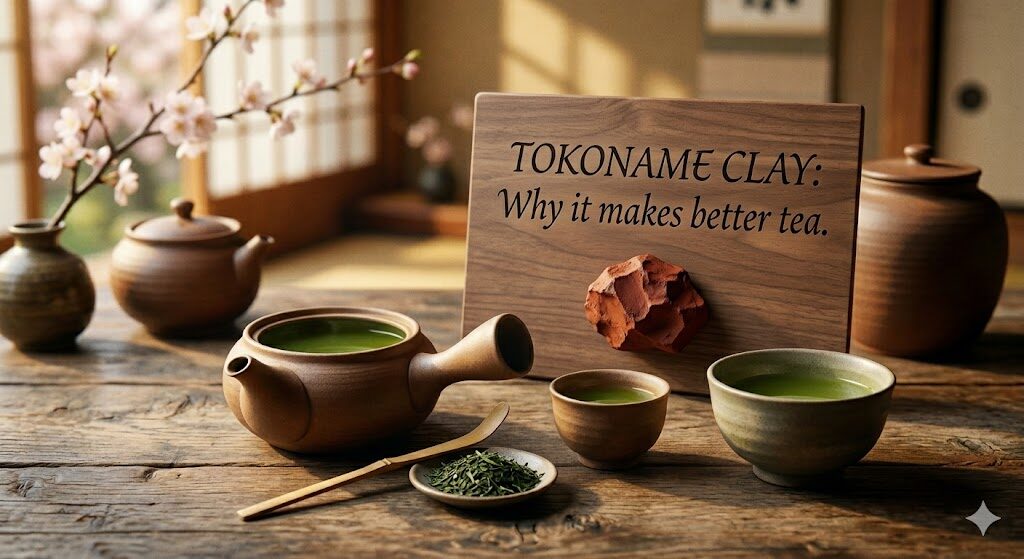
Why Tokoname Clay Makes Better Tea: Iron, Minerals & Chemistry
Tokoname-yaki has been Japan’s most important teaware pottery tradition for over 900 years. The specific red-brown clay of Tokoname City in Aichi Prefecture is not merely traditional — it has documentable effects on
The Mineral Composition of Tokoname Clay
Tokoname clay is distinctive for its high iron content, concentrated in the form of iron oxide minerals. The characteristic dark red-brown color comes from this iron. When the clay is fired at high temperatures (1,200-1,280C), the iron forms a specific ceramic matrix that has the following properties relevant to
- Slight natural alkalinity from the mineral composition
- Microporous structure that retains heat effectively
- Surface chemistry that interacts with water and
tea compounds - Very low thermal conductivity compared to glass, allowing even temperature distribution
How Tokoname Clay Affects Tea Chemistry
Several mechanisms explain the flavor improvement Tokoname kyusu users consistently report:
Tannin interaction: The iron in the clay wall interacts with tannic compounds in
Water softening: Tokoname clay’s slight alkalinity affects water chemistry, particularly with hard water. Slightly alkaline contact conditions can improve extraction of desired flavor compounds while reducing harsh metallic notes. If your tap water is hard, a Tokoname kyusu may significantly improve your
Heat retention and distribution: The thick walls and specific thermal properties of Tokoname clay maintain stable brewing temperature better than glass or thin porcelain. This matters for teas like sencha and gyokuro where temperature consistency during steeping affects flavor balance.
The Seasoning Effect
Tokoname kyusu improves with use — the clay’s microporous structure gradually absorbs
This is why dedicated Tokoname users often have separate kyusu for sencha, gyokuro, and oolong — cross-contamination of the clay’s seasoning muddies the character that develops over hundreds of brewing sessions.
To develop seasoning, never wash the interior with soap. Rinse with hot water only, and allow to dry completely after each use. Browse our Tokoname kyusu selection here.
Tokoname vs Other Clay Teapots
Several other Japanese pottery traditions produce teaware that competes with Tokoname:
- Banko-yaki (Mie Prefecture) — double-walled structure, exceptional heat retention, slightly different mineral composition. Excellent for black
tea and robust green teas. - Shigaraki-yaki — natural ash glaze effects, good for oolong and aged teas, less specifically aligned to green
tea chemistry than Tokoname. - Kyoto Kiyomizu-yaki — more decorative, porcelain-influenced, less mineral interaction with
tea . Beautiful but different purpose.
For Japanese green
Identifying Authentic Tokoname Kyusu
The Tokoname name is controlled but not perfectly protected. Authentic indicators:
- The characteristic dark red-brown or reddish clay body (visible in unglazed areas)
- Potter’s mark or studio stamp on the base
- Weight — should feel substantial for size, not hollow
- The characteristic metallic sheen of the clay surface in raking light
- Made in Tokoname City, Aichi Prefecture — not just “made in Japan”
Caring for Tokoname Clay
Basic care preserves the clay’s properties:
- Rinse with hot water after each use, never soap on the interior
- Allow to dry completely with the lid off before storing
- Avoid thermal shock (no cold water on a hot kyusu)
- Store in a ventilated space, not a sealed cabinet
- If a slight musty smell develops, steep a strong sencha inside for 30 minutes and rinse
Frequently Asked Questions
Does the Tokoname effect work with cheap Tokoname pots?
To some degree. The underlying chemistry depends on the clay mineral content, which is present in any authentic Tokoname clay regardless of price. However, lower-priced Tokoname kyusu often have coarser manufacturing quality, less refined filters, and the clay may be blended with non-Tokoname materials. Higher-quality pieces from established potters use purer local clay with more consistent mineral composition.
Can I use my Tokoname kyusu for different teas?
Technically yes. But to develop seasoning and protect the accumulated character of the clay, it’s best to dedicate a kyusu to one
How long does it take to season a Tokoname kyusu?
Meaningful seasoning develops after approximately 50 to 100 uses. You’ll notice the
Is there scientific proof that Tokoname clay improves tea ?
Yes, at least partially. Studies have measured tannin reduction in
What size Tokoname kyusu should I buy?
For solo brewing or gyokuro (which brews in very small volumes), 100-200ml. For 1 to 2 people sharing sencha, 250-350ml. For general household use, 400-500ml. The size affects the leaf-to-water ratio you can achieve consistently. Many dedicated