Sencha and Gyokuro Brewing Guide: Complete Temperature Chart
Temperature is the single most important variable in Japanese green
Why Temperature Matters So Much
Japanese green
- L-theanine (sweetness, umami) — extracts readily at all temperatures, even cold water
- Catechins/tannins (bitterness, astringency) — extract rapidly above 70C; minimal extraction below 60C
- Caffeine — extracts progressively with temperature; more at 80C than 60C
- Aromatic compounds — highly volatile; some are lost at boiling temperature, best captured at moderate heat
Lower temperatures = more sweetness, less bitterness, less caffeine, more aromatic complexity
Higher temperatures = more bitterness, more caffeine, less aroma, fuller body
Complete Japanese Green Tea Brewing Chart
| Tea Type | Temperature | Amount | Water | Steep Time |
|---|---|---|---|---|
| Gyokuro (premium) | 50-55C | 1 tsp | 40-60ml | 90-120 sec |
| Gyokuro (standard) | 55-60C | 1 tsp | 60-80ml | 60-90 sec |
| Kabusecha | 65-70C | 1 tsp | 120ml | 45-60 sec |
| Sencha (premium) | 65-70C | 1 tsp | 150ml | 45-60 sec |
| Sencha (standard) | 70-75C | 1 tsp | 150ml | 45-60 sec |
| Fukamushi sencha | 70C | 1 tsp | 150ml | 30-40 sec |
| Shincha/first flush | 65-70C | 1 tsp | 150ml | 30-45 sec |
| Genmaicha | 80-90C | 1 tsp | 150ml | 60-90 sec |
| Bancha | 85-95C | 1 tsp | 200ml | 45-60 sec |
| Hojicha | 90-95C | 1.5 tsp | 200ml | 30-45 sec |
| Kukicha (green) | 80-85C | 1 tsp | 180ml | 45-60 sec |
| Konacha | 80-85C | 0.5 tsp | 150ml | 20-30 sec |
How to Reach the Right Temperature Without a Thermometer
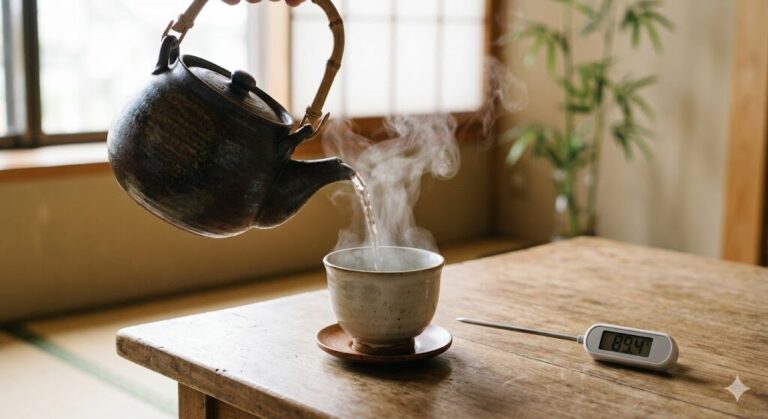
A temperature-controlled kettle is ideal, but not everyone has one. Here’s how to reach target temperatures using a standard kettle:
- 50C — pour boiling water into a kyusu, pour from kyusu into serving cup, pour back into brewing vessel. Each pour drops approximately 10-15C. Two to three transfers get you to 50C.
- 60C — one to two transfers from boiling water
- 70C — bring water just to a boil, pour into a kyusu and allow to sit 2 minutes, or transfer once
- 80C — let freshly boiled water sit in the kettle for 4-5 minutes, or transfer once without allowing additional cooling
- 90C — freshly boiled water poured into brewing vessel directly; the pouring itself drops temperature a few degrees
The Pre-Warming Ritual
Prewarming is not optional for precision brewing. A cold kyusu or teacup drops water temperature by 10-15C immediately on contact. Always prewarm:
- Fill brewing vessel (kyusu) with hot water, swirl, and discard
- Fill serving cups with hot water, hold for 30 seconds, discard
- Now add your leaf and water at target temperature to the warmed vessel
This five-step ritual (heat water, warm kyusu, warm cups, measure leaf, brew) takes 3 minutes total and consistently produces better results than cutting steps. Browse our sencha options here and gyokuro here.
Multiple Steepings: Parameters for Each Round
Japanese green
Second steep: Increase temperature by 5-10C. Reduce steep time by 25%. Pour immediately when time is up.
Third steep: Increase temperature another 5-10C. Return to similar or slightly longer steep time as second steep.
For gyokuro specifically, the second steep at 60-65C for 45 seconds often produces the finest, most layered cup of the session. Many practitioners consider the second steep the “peak” of the gyokuro brewing session.
Frequently Asked Questions
Do I need a thermometer or can I estimate temperature?
For everyday brewing, estimation with the transfer method works well. For premium gyokuro and kabusecha where the temperature window is narrow (5C off significantly changes the cup), a temperature-controlled kettle or an instant-read thermometer is worth the investment. For sencha, hojicha, and genmaicha, estimation is entirely adequate.
Why does my sencha turn bitter despite using the right temperature?
Check three things: steep time (even 15 extra seconds matters), leaf quantity (too much leaf relative to water intensifies bitterness), and water quality (very hard water amplifies bitterness). Also confirm your temperature is accurate — even experienced brewers sometimes add too-hot water by habit. A thermometer check occasionally is worthwhile.
Can I reuse green tea leaves from one day to the next?
No. Once steeped and exposed to air,
Is there a “best” vessel for brewing sencha?
A ceramic or Tokoname clay kyusu with a fine-mesh filter integrated into the spout. The filter holds back even fine leaf particles, the clay moderates temperature, and the narrow spout allows controlled pouring. Glass is excellent for visual inspection and works well for a watching the leaves unfurl. For gyokuro, a shiboridashi or houhin (lidded bowl with filter ridge) is traditional and effective.
What is the correct way to pour sencha — fast or slow?
Pour at a moderate pace, consistent and continuous. Too fast: turbulent pouring agitates the leaves and extracts more catechins. Too slow: the