Japanese Tea Farming Economics: What You Need to Know
The average Japanese green tea farmer is over 65 years old. The average Japanese green tea consumer is over 55. Between these two demographic facts sits a industry in quiet crisis — one that produces some of the most complex, culturally significant food products in the world while watching the people who make it and the people who buy it both age out of the system at the same time.
Understanding what’s happening to the Japanese tea industry isn’t just trivia. It explains why certain teas are harder to find, why prices for authentic first-flush teas trend upward, and why the tea you’re drinking today from a specific farm or region might not exist in the same form in 20 years.
The Ochabanare Problem: Japan Is Leaving Tea Behind
Ochabanare (お茶離れ) — literally “the leaving-tea trend” — describes a generational shift in how Japanese people consume tea. It’s not that Japan is drinking less tea. Total tea beverage spending remains high. What’s changed is the form.
The numbers are stark. Brewing tea in a kyusu (traditional Japanese teapot) uses approximately 5 grams of loose leaf per 120ml of water. A standard 500ml PET bottle of ready-to-drink green tea uses approximately 3 grams of tea for the entire bottle. The math: teapot brewing consumes tea leaves at roughly seven times the rate of PET bottle consumption by volume of beverage produced.
As younger Japanese consumers shift from teapot brewing to PET bottles, the volume of tea leaves they consume per liter of tea they drink drops by 85%. The total market for tea beverages remains roughly stable. The market for actual tea leaves — the thing farmers grow and sell — collapses.
The Quality Cascade
The quality dimension of this shift compounds the quantity problem. PET bottle producers primarily use sanban-cha (third-harvest) and yonban-cha (fourth-harvest) leaves — the lowest grade material, harvested in late summer and autumn from older, more mature growth. Traditional teapot brewing uses ichiban-cha (first-harvest) and nibancha (second-harvest) — the premium early-season leaves that carry the highest price and represent the best of each farm’s production.
As PET consumption rises and domestic teapot brewing falls, the domestic market for first-harvest premium leaves has shifted. However, surging international demand — particularly for matcha and premium sencha — has driven ichiban-cha prices to record highs in recent years. First-flush tencha prices in Kyoto rose 265% and Kagoshima first-harvest sencha prices climbed roughly 40% in 2025 alone. This export-driven demand has reshaped the economics: farmers who can access international markets benefit, while those reliant solely on declining domestic channels face pressure.
This creates a quality spiral: declining demand for premium tea reduces the premium price premium farmers receive → farmers reduce investment in practices that generate premium quality → quality of available premium tea declines → declining quality reduces demand further. It’s a slow spiral, tracked over decades rather than seasons, but the trajectory is visible.
The Demographic Clock
Japanese agriculture broadly faces a succession crisis. Tea farming is experiencing it particularly acutely.
Who Is Farming Japanese Tea
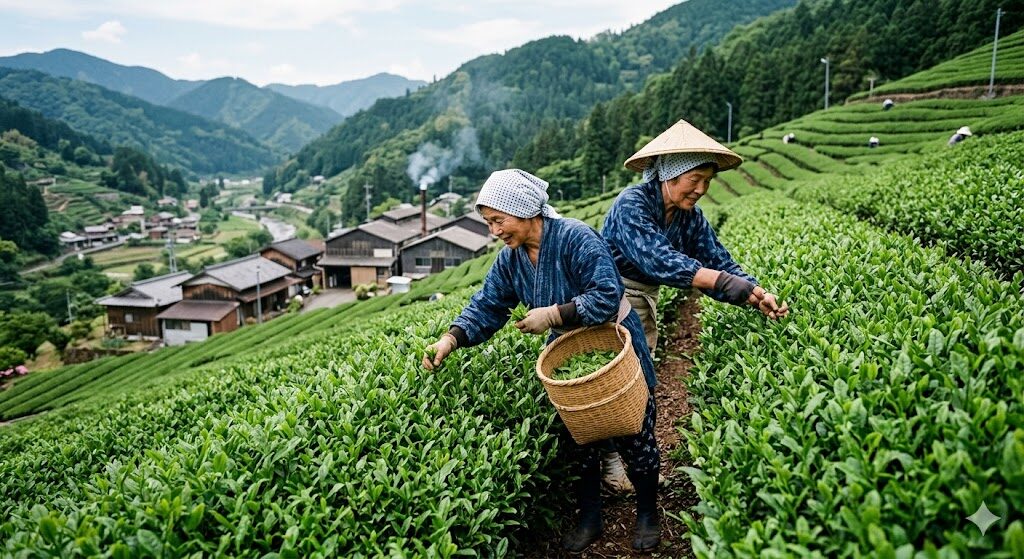
The average Japanese tea farmer is over 65. This is not a problem of the near future — it’s a present reality in virtually every tea-producing region. Shizuoka, which produces about 40% of Japan’s tea, has documented the contraction of its farming population over decades. Small family-operated tea gardens — which produce much of Japan’s characterful, regionally specific tea — are closing as farmers retire with no family members prepared to take over.
The reasons younger generations cite for not entering tea farming are consistent across regions: physical labor demands, seasonal income uncertainty, the isolation of rural agricultural life, and the social perception that farming is “un-trendy” compared to urban office careers. Japan’s intense urbanization has pulled young people toward cities for two generations, and tea farming requires the kind of place-specific commitment that’s increasingly hard to sustain when cities offer stability and cultural participation that rural areas don’t match.
What Happens When Farms Close
The immediate consequence of farmer retirement without succession is typically one of three outcomes:
- Consolidation: Neighboring operations absorb the land. This tends to favor efficiency (larger mechanized operations) over quality (small-garden diversity and experimentation). Consolidated operations typically produce decent commodity tea, not exceptional single-garden tea.
- Abandonment: Tea gardens require constant management — pruning, cultivation, fertilization, pest management. Abandoned gardens degrade rapidly. In mountainous terrain, terraced gardens that required significant labor to construct can become unmanageable within a few years of neglect. Reestablishing abandoned gardens is extremely expensive and takes years before productive harvest.
- Conversion: Some agricultural land converts to other uses — residential development, different crops, managed forest. Once converted, the specific terroir conditions that made a tea garden exceptional (soil microbiology, drainage patterns, accumulated organic matter, shading from established trees) cannot be replicated by replanting later.
The Terroir Question: What We Stand to Lose
Japanese tea quality is inseparable from place. The specific flavor profiles that distinguish Uji gyokuro from Yame gyokuro, or Shizuoka sencha from Kagoshima sencha, are products of decades or centuries of cultivation in specific locations with specific conditions. These aren’t easily replicated.
Terroir in the context of Japanese tea has two components that research in Uji has helped define:
- Natural environment: Climate patterns, soil composition and structure, topography (slope angle, aspect, drainage, proximity to water), and cultivar genetics adapted to the location over generations
- Agricultural practice: The accumulated human knowledge of when to pick, how to shade, how to prune, how to process — knowledge that’s transmitted through apprenticeship and multi-generational family farming, not through manuals or formal education
The second component is the one at most immediate risk. The natural environment changes slowly (though climate change is accelerating that). Agricultural knowledge disappears with the generation that carries it. When a 70-year-old tea farmer retires and there’s no successor, the intangible knowledge they carry — when the morning fog in this valley is right to start shading, which rows of their garden need different pruning angles, how the flavor of their soil changes with rainfall — vanishes with them.
Research institutions and some prefectural governments have begun documentation projects, recording knowledge from veteran farmers before they retire. But documented knowledge is a shadow of practiced knowledge. A written description of shading timing is not the same as a decade of intuitive observation.
What the Industry Is Doing
Direct-to-Consumer Models
Traditional Japanese tea distribution involves multiple intermediary steps: farmer → JA (agricultural cooperative) → wholesaler → retailer. Each step reduces the farmer’s margin. A farmer who sells through traditional channels might receive 30–40% of retail price for their highest-quality tea. Direct-to-consumer sales — mail order, subscription services, overseas export to specialty importers — eliminate intermediaries and allow farmers to capture more of the value of exceptional tea.
This model works particularly well for farms producing distinct, identifiable, characterful teas that justify the story-driven marketing that direct sales enable. It’s harder for commodity producers and for small operations that lack the time for customer relationship management alongside all the other demands of farming.
Youth Market Innovation
The ochabanare problem has prompted some farms to meet younger consumers where they are rather than expecting younger consumers to adopt traditional brewing habits. The partnership between Arahataen Green Tea Farms in Shizuoka and Shizuoka Commercial High School produced “Green Tea with Lemon” and “Green Tea with Mikan (Japanese orange)” — products designed around youth preferences for sweet, fruity, convenient beverages. Critically, they use premium powdered tea rather than low-grade industrial tea, specifically targeting convenience while maintaining quality.
This approach has limits — not every farm has the capacity for product development, and niche youth-oriented products don’t address the fundamental economics of loose-leaf tea farming. But it represents an attempt to expand what Japanese tea can be rather than defending a shrinking traditional market.
Smart Agriculture and Technology
Japan’s 2024 Smart Agricultural Technology Act specifically addresses the labor shortage crisis in agriculture — of which tea farming is a prominent example — by promoting automation, robotics, and data-driven farm management. Tea harvesting machinery has existed for decades, but precision systems that can distinguish between leaf quality grades and optimize harvest timing using sensor data are relatively new. For operations large enough to justify the capital investment, automation partially compensates for labor shortages.
The challenge is that mechanized harvesting fundamentally changes what tea can be produced. The most delicate first-flush material — the kind picked by experienced hands at precisely the right moment — doesn’t translate to machine harvest. The economic and sensory ceiling of a fully mechanized tea operation is lower than a skilled hand-harvest operation.
Heritage and Certification Systems
Several Japanese tea regions and practices have pursued international recognition as a way to create market differentiation:
- Chagusaba (FAO GIAHS designation): The traditional Shizuoka practice of using meadow grass as mulch between tea rows. The GIAHS designation recognizes both its agricultural value and its ecosystem maintenance function — preserving biodiversity in the grassland communities that provide the mulch material.
- Ujicha GI protection: “Uji Tea” has a specific geographic definition (grown in Kyoto, Nara, Shiga, or Mie, processed by Kyoto-based wholesalers) that protects the name from dilution by lower-quality tea marketed under the Uji brand. GI protection provides legal infrastructure for premium pricing but requires enforcement capacity that small farming cooperatives don’t always have.
The MIDORI Strategy
Japan’s Ministry of Agriculture, Forestry, and Fisheries launched the MIDORI Strategy in 2021 — a 30-year framework targeting carbon neutrality, reduced chemical inputs, and 25% organic farming by 2050. For tea specifically, the strategy supports organic certification programs and sustainable cultivation methods that can command market premiums. The connection between environmental sustainability and premium pricing is one of the clearest paths to better economics for small-scale producers — organic, single-origin, transparently grown tea can justify prices that support viable farming operations even with higher labor costs.
The Export Dimension
One significant development: Japanese green tea exports have grown substantially over the past decade, driven by international interest in matcha (particularly in food service applications — matcha lattes, matcha-flavored foods) and growing specialty tea markets in North America, Europe, and Australia. Export prices are often meaningfully higher than domestic commodity prices.
For farms producing specialty material, international specialty tea buyers represent a significant economic lifeline — and one that values exactly the qualities that the domestic PET bottle market devalues. The international specialty tea market pays premiums for first-flush material, single-garden provenance, hand-harvested tea, and traditional processing methods. These are precisely the things that make traditional Japanese tea farming economically viable if the market can be accessed.
The challenge is market access infrastructure: language, relationships with international importers, regulatory compliance for food exports. These require capacity that individual small farms often lack. Prefectural governments and farm cooperatives have been building this infrastructure — with mixed results — over the past decade.
What This Means for Tea Buyers Outside Japan
- Prices for authentic first-flush Japanese tea will continue rising: Shrinking supply of skilled farmers, increasing input costs, and a market (international specialty) that understands and pays for quality creates structural upward price pressure for the best material
- Provenance matters more: As the number of traditional farms declines, knowing which specific farm produced your tea — and whether that farm has a succession plan — becomes relevant to whether the tea will be available in future years
- Supporting specialty importers is supporting the farms: Specialty tea importers who pay transparent, above-commodity prices directly to farmers are part of the economic system that keeps traditional tea farming viable. Understanding this supply chain is relevant for consumers who care about the continuation of what they’re drinking
- The matcha boom has side effects: The international matcha demand surge has been economically positive for many farms but has also created quality problems — significant quantities of lower-grade matcha and tencha are being marketed internationally as premium when they’re not. Understanding quality indicators (shade duration, cultivar, growing region, processing) matters more in a crowded market
Frequently Asked Questions
What is ochabanare?
Ochabanare (お茶離れ) describes the trend of younger Japanese consumers moving away from traditional loose-leaf tea brewing (in a kyusu teapot) toward ready-to-drink PET-bottled tea beverages. The word combines “ocha” (tea) with “hanare” (to leave, to separate from). The trend has significant economic consequences for tea farmers because PET bottle production uses far less tea leaf per volume of beverage than traditional brewing, and uses lower-grade material.
Why don’t young Japanese people brew loose-leaf tea at home?
Multiple factors: smaller living spaces that don’t accommodate traditional tea equipment; apartment lifestyles that favor quick, convenient beverage options; a cultural association of teapot brewing with older generations; and the simple accessibility of high-quality cold-brew RTD beverages from Japanese convenience stores and vending machines. Japanese convenience store culture — where excellent tea beverages are available for ¥100–200 anytime — makes the time investment of teapot brewing a harder sell. The issue isn’t quality appreciation; many young Japanese people understand and enjoy good tea. The issue is that the convenience gap between brewing and buying has widened.
Is Japanese tea becoming more expensive?
For genuine high-quality, first-flush, specialty-grade Japanese tea, yes — structurally. Input costs (labor, fertilizer, equipment) have risen; the skilled farmer pool is shrinking; international demand for premium material has increased. These factors combine to push prices upward for authentic premium tea. Commodity-grade green tea used in PET bottles and bulk food service applications remains price-competitive, but the mid-to-high tier of quality Japanese tea has seen meaningful price increases over the past decade.
What is the Chagusaba method?
Chagusaba is a traditional cultivation practice from Shizuoka where cut grass from nearby semi-natural grasslands is spread between tea rows as mulch. This practice insulates roots from frost, retains soil moisture, suppresses weeds, and feeds soil microorganisms as the organic material decomposes. The grasslands that provide the mulch material — called “uchiyama” (inner mountain grasslands) — require their own management. The FAO has recognized the Chagusaba system as a Globally Important Agricultural Heritage System (GIAHS) for maintaining both tea quality and regional biodiversity.
How does the aging farmer problem affect the tea I buy?
In several ways: the unique knowledge that experienced farmers carry — about their specific terroir, microclimate management, and the subtleties of their cultivars — doesn’t transfer easily. As veteran farmers retire, some of that knowledge disappears. Gardens that had distinctive character over generations can lose that distinctiveness under new management or consolidation. The most immediate practical effect is that specific farms and gardens that have produced consistently excellent teas may produce differently or cease operating as farmers retire. Buying from farms with clear succession plans, or from importers who maintain multi-year direct relationships with specific farms, provides some insurance against this.