Tetsubin Cast Iron Kettle: The Complete Buying and Care Guide
You found a beautiful cast iron teapot online. The listing calls it a “tetsubin.” You buy it, take it home, set it on the stove to heat water — and you ruin a $200 piece of equipment in under five minutes.
This happens constantly. And it happens because the Western market routinely mislabels two completely different tools under the same name. Before anything else — before history, before pricing, before which brand to buy — you need to know which vessel you actually have.
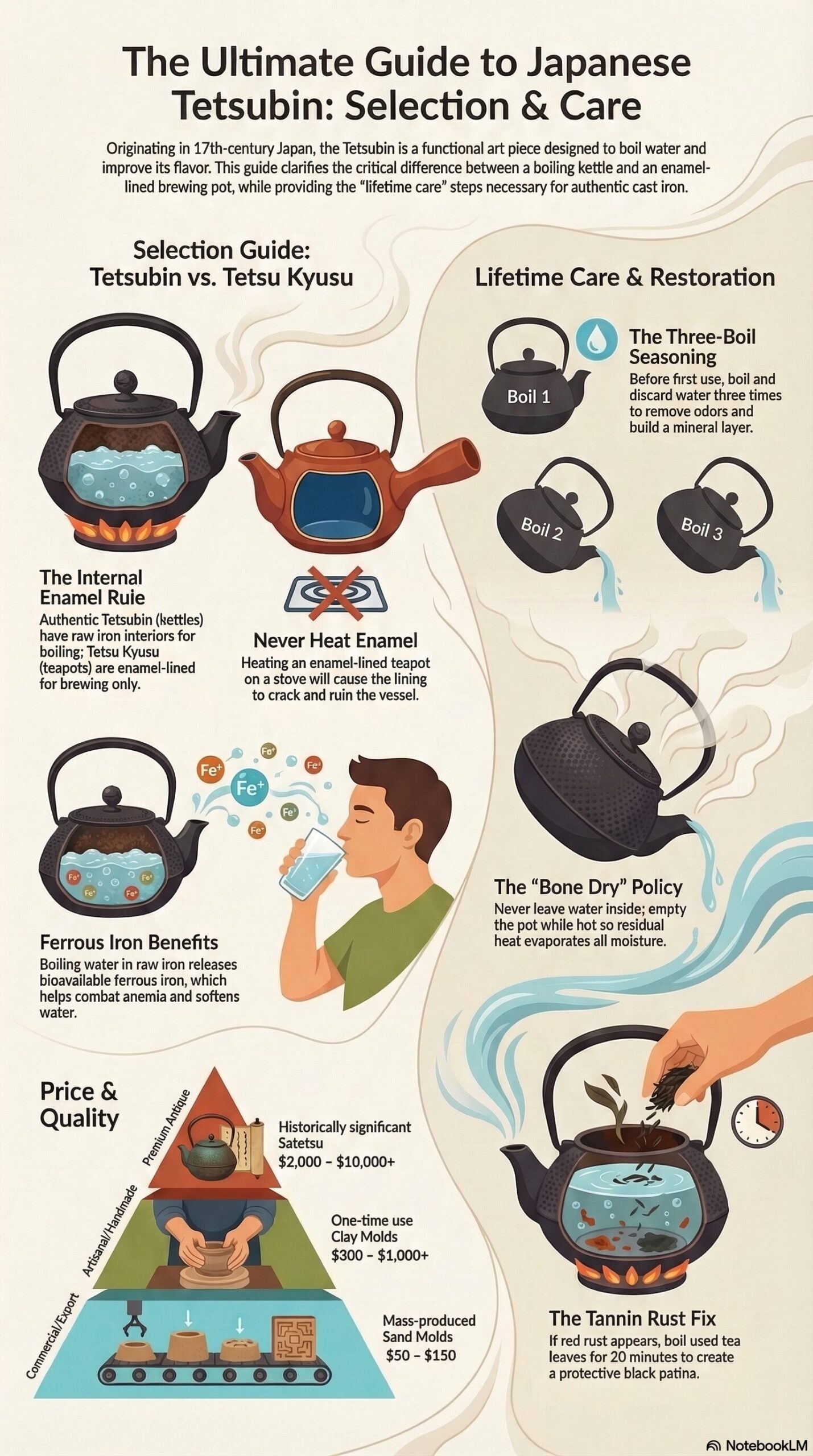
Tetsubin vs Tetsukyusu: The Crucial Difference You Must Know First
These two tools look nearly identical. Both are Japanese cast iron. Both are used in
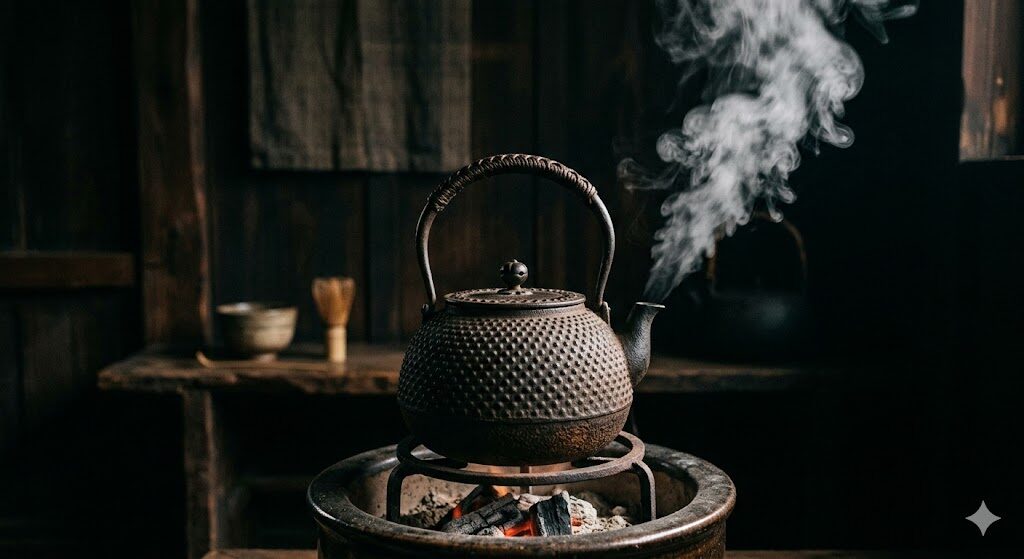
Tetsubin (鉄瓶) is a cast iron water kettle. The interior is raw, uncoated iron. You fill it with water and boil it directly on a heat source — gas, induction, or charcoal brazier. The raw iron interior is the point: boiling water in uncoated iron releases trace ferrous iron (Fe2+) into the water, softening its character and improving
Tetsukyusu (鉄急須) is a cast iron teapot. The interior is coated with enamel — a glassy, non-reactive surface applied during manufacturing. You pour already-boiled water into it to brew loose-leaf
| Feature | Tetsubin (鉄瓶) | Tetsukyusu (鉄急須) |
|---|---|---|
| Interior | Raw uncoated iron | Enamel-coated |
| Purpose | Boil water | Brew |
| On a heat source? | Yes — designed for it | Never — will destroy enamel |
| Typical size | 1–2.5 liters | 0.3–1 liter |
| Iron enrichment | Yes — from raw interior | No — enamel blocks contact |
| Typical price range | $80–$3,000+ | $40–$400+ |
| Interior rust over time | Normal — do not remove | Should not rust (enamel protects) |
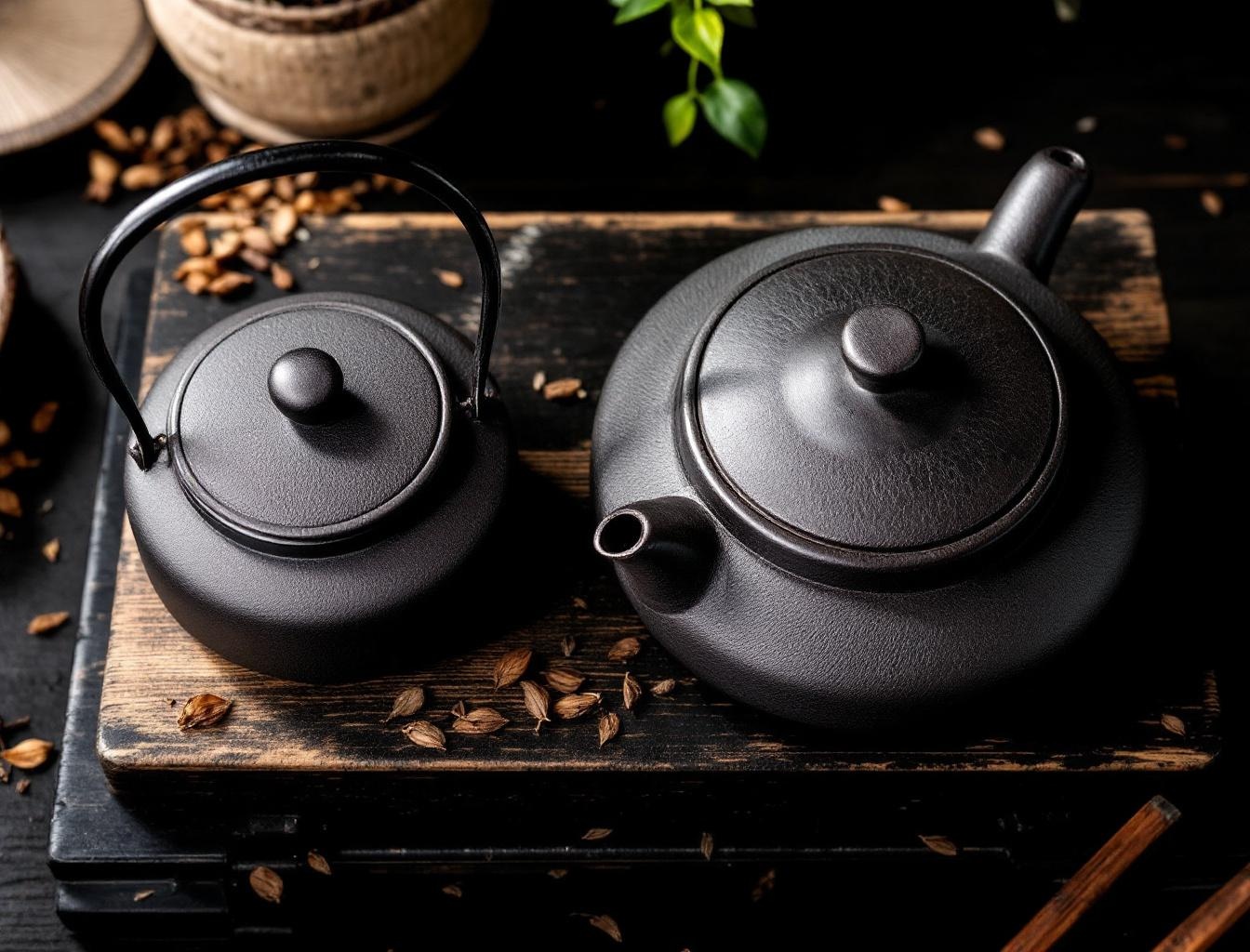
When you shop, check the product listing carefully. If it says “enamel interior,” you have a tetsukyusu. If the description mentions “iron enrichment” or “mineral water,” you have a tetsubin. When in doubt, contact the seller directly and ask whether the interior is coated before applying any heat.
What Is a Tetsubin? History from the Edo Period to Today
The tetsubin traces its origins to the 17th century, in the Nambu domain — a feudal territory corresponding to modern Iwate Prefecture in northern Japan’s Tohoku region. Iwate’s mountains are rich in high-quality iron ore, and the area had already developed sophisticated iron casting techniques used for weapons, agricultural tools, and Buddhist temple bells.
The catalyst for tetsubin’s rise was cultural, not material. During the mid-Edo period, sencha — steeped loose-leaf
Existing iron vessels from the period — primarily kama, the large iron water cauldrons used in formal
The craft tradition that emerged from this period is called Nambu Tekki (南部鉄器), meaning “Nambu ironware.” It encompasses both tetsubin and a wide range of iron cookware. The tradition is alive today in Iwate Prefecture, where ironmasters in the cities of Morioka and Mizusawa continue to produce tetsubin using methods descended from Edo-period techniques. Nambu Tekki received Japan’s national designation as a traditional craft (dentō kōgeihin) in 1975.
The outside world discovered tetsubin largely through the global
The Science: How Tetsubin Improves Your Water Quality
The claim that tetsubin “improves water quality” sounds like marketing language until you understand the specific chemistry involved. There are two distinct mechanisms at work.
Iron Mineral Release
When water is boiled in an uncoated iron vessel, a small amount of ferrous iron (Fe2+) dissolves into the water. Research has measured this at approximately 0.042mg per 100ml of water — a trace amount, below safe dietary thresholds, but enough to be functionally significant.
This dissolved iron produces what Japanese
Chlorine Binding
Tap water in most cities contains residual chlorine as a disinfectant. Chlorine at the concentrations found in tap water doesn’t make water unsafe, but it does interfere with
Ferrous iron (Fe2+) binds readily with chlorine during boiling, effectively neutralizing it. Water boiled in a tetsubin tastes noticeably cleaner than the same water boiled in a stainless steel kettle, even before you account for the iron enrichment itself. This is the primary reason experienced
The Dietary Iron Angle
At 0.042mg per 100ml, a single large cup of tetsubin-boiled water contributes a small but real amount of dietary iron — particularly relevant for people who drink multiple cups of
Tetsubin Pricing Tiers: What the Money Actually Buys
Tetsubin prices span an enormous range — from $60 to $3,000 and beyond — and understanding why helps you make the right choice for your situation.
| Tier | Price Range | Construction | Pattern Quality | Best For |
|---|---|---|---|---|
| Entry | $50–$200 | Sand molds (reusable) | Softer edges, less definition | Daily use, first tetsubin |
| Mid-range | $200–$450 | Quality sand molds, hand-finished | Sharper detail, better lid fit | Serious |
| Premium | $450–$3,000+ | Clay molds (yakigata), broken after single casting | Razor-sharp arare, virtually unique | Collectors, heirloom pieces |
Entry Level: Sand Molds
Most tetsubin at accessible price points are made using sand molds — compacted sand mixed with a binding agent, shaped around a pattern master. Sand molds can be reused many times, which reduces per-unit cost. The patterns are real and often attractive, but under close inspection you’ll see softer edges and slightly less crisp definition than higher tiers. For daily
Mid-Range: The Sweet Spot
In the $200–$450 range, you get meaningfully better craftsmanship: better lid fit (the lid should sit flush and still without rattling when you lift the kettle), finer surface texture, and in many cases hand-applied finishing by the ironsmith. This tier is where most serious home
Premium: Yakigata Clay Molds
The upper tier uses a technique called yakigata — molds carved from clay by hand, then fired. Each clay mold produces only one or two castings before being broken apart. This means every premium tetsubin is, in a practical sense, a unique object. The process requires 60 or more separate steps; some masters spend months on a single piece.
The most distinctive feature of premium work is the arare (霰) pattern — the classic tiny raised hemispheres that cover the surface like frozen hailstones. In machine-assisted or sand-mold pieces, these dots have visible flat tops and inconsistent spacing. In yakigata work, each dot is sharply round, perfectly domed, and laid with geometric precision. The difference is immediately visible side by side.
At $1,000+, you are buying a functional art object. The
What to Look for When Buying a Tetsubin
Size
Choose based on how you actually make
- 0.6–1L: Single person, 1–2 cups at a time. Heats faster, takes up less space. Best for office or desk use.
- 1–1.5L: 1–3 people. The most versatile size for home use. Refills are frequent enough to keep the water fresh.
- 1.5–2L: 2–4 people. Good for
tea ceremony settings or households that drinktea continuously throughout the day. - 2L+: Group settings,
tea events, or anyone who wants to minimize the number of refills. Heavier when full — consider your stove setup.
Pattern
Tetsubin patterns are functional as well as decorative. The textured surface of an arare (hailstone dot) pattern actually increases surface area slightly, aiding heat distribution and retention. Beyond that, pattern choice is personal. Common options include arare (dots), waves (nami), plum blossom (ume), pine needle (matsu), and various nature motifs.
Weight and Wall Thickness
Heavier tetsubin have thicker walls. Thicker walls mean better heat retention — the water stays hot longer after you remove it from the heat source, and the iron radiates gentle heat for longer. For
Lid Fit
Test this if you can. A well-made tetsubin lid sits flush in the opening without play. When you tip the kettle to pour, the lid should stay put without you holding it. A loose, rattling lid is a sign of poor manufacturing tolerances — fine for a very cheap vessel, but not acceptable in anything above entry level.
Counterfeit Warning
The surge in interest in tetsubin has produced a large volume of low-quality imitations. Indicators of a counterfeit or inferior product:
- Price below $40–$50 for a “handmade” or “authentic” piece
- Ships from outside Japan (check seller location and shipping origin)
- Incorrect, garbled, or nonsensical Japanese text on the body or packaging
- No manufacturer name, no region of origin listed
- Descriptions that say “Nambu” or “Nambu Tekki” but list China as the production country
Many of these pieces are cast in China from cheaper iron alloys, sometimes with thinner walls and inconsistent quality control. They may still function as kettles, but they are not Nambu Tekki, and they are often mislabeled in ways that lead to the tetsukyusu/tetsubin confusion described above.
Authentic Nambu Tekki: Recommended Brands
Authentic tetsubin carry the 南部鉄器 (Nambu Tekki) mark and specify Iwate Prefecture, Japan as their place of manufacture. Here are the four foundries most accessible to international buyers:
Iwachu (岩鋳)
Founded in 1902 in Morioka, Iwachu is the most internationally distributed Nambu Tekki foundry. Their pieces are available through reputable
Oigen (及源鋳造)
A family foundry operating continuously since 1852, Oigen produces tetsubin with a slightly warmer, more weathered aesthetic than Iwachu’s crisper work. Their pieces are available through select international retailers and their own website. If you want something with genuine historical continuity — the same family, the same methods, for over 170 years — Oigen is worth seeking out.
Kamasada (釜定)
One of the more artisan-focused Morioka foundries, Kamasada produces smaller runs of higher-quality pieces. Their work sits in the mid-to-premium range and is aimed at buyers who see tetsubin as functional craft objects. Less internationally distributed than Iwachu; expect to source through Japan-focused import shops or directly.
What to Verify at Purchase
Regardless of brand, confirm:
- The listing specifically states 岩手県 (Iwate Prefecture) or 盛岡 (Morioka) / 水沢 (Mizusawa) as the production location
- The piece carries a 南部鉄器 mark, either embossed on the base or on accompanying documentation
- The seller is an established
tea or Japanese craft specialty retailer — not a general marketplace drop-shipper
How to Season Your New Tetsubin (First Use)
A new tetsubin comes with manufacturing residue — trace oils, fine iron particles from the casting and finishing process — that you need to clear before the vessel is ready for use. This is called seasoning, but it works very differently from how you season a cast iron skillet.
Do not use oil. Tetsubin seasoning is water-only. Oil coats the interior and blocks the iron-water contact that gives tetsubin water its character.
The process:
- Fill with cold water to about 70% capacity. Leave room for water movement.
- Boil fully on medium heat.
- Discard the water. It will likely look slightly cloudy or have a faint metallic color. This is normal.
- Repeat 3–4 times, or until the boiled water runs clear with no discoloration.
- After the final rinse, empty immediately while still hot and allow to air-dry on the heat source with the lid off.
After these initial boils, your tetsubin is ready. Over the first weeks of regular use, the interior will develop a dark reddish-brown mineral scale called yakan (sometimes called “tea scale” in English descriptions). This scale is correct and desirable — it is the patina that characterizes a well-used tetsubin and contributes to the water character. Do not scrub it off.
Daily Care, Rust Management, and Long-Term Maintenance
After Each Use
The single most important care step for a tetsubin is also the simplest: empty it while still hot. Residual heat from the cast iron evaporates the remaining moisture inside the kettle. If you let water sit in a tetsubin overnight, rust accelerates dramatically. If you empty it hot and leave the lid slightly ajar, the residual heat does the drying work for you.
Never use soap inside a tetsubin. Soap disrupts the developing mineral scale and leaves residue that affects water flavor. Exterior cleaning with a soft damp cloth is fine; interior cleaning is water-only.
Never put a tetsubin in a dishwasher.
Understanding Interior Rust
Some surface rust inside a tetsubin is normal, particularly in the early months before the mineral scale has fully developed. The key is to distinguish normal surface discoloration from active deep rust.
Normal: A reddish-brown coating that is relatively even, adhered to the surface, and does not flake into your boiling water. This is iron oxide that is actively bonding with the iron surface to form a protective layer.
Concerning: Loose, flaking rust that comes off when you gently wipe the interior with a cloth, or rust that produces visibly discolored water after several seasoning boils. This requires intervention.
Do not scrub interior rust with abrasives. Metal brushes and scrubbing pads damage the mineral scale and create micro-scratches that accelerate future rusting. If you have light flaking rust, more seasoning boils usually resolve it.
The Tea Dyeing Technique for Established Rust
For more significant rust that is producing discolored water even after repeat boiling, Japanese ironware craftsmen use a technique called
- Brew a very strong batch of tannin-rich
tea — bancha, hojicha, or kukicha work well; sencha also works. Use 3–4 times the normaltea quantity. - Pour the brewed
tea (not the leaves) into the tetsubin and fill to capacity with this strongtea liquid. - Simmer gently for 20–30 minutes. Do not boil vigorously.
- Discard, rinse with plain water, and then boil plain water twice more and discard.
- Empty while hot and allow to dry completely with the lid ajar.
The tannins in the
Long-Term Storage
If you won’t use a tetsubin for more than a few weeks:
- Ensure it is completely dry inside before storage
- Store with the lid ajar, not sealed shut
- Keep in a low-humidity environment — not under the sink, not in a damp cabinet
- A small packet of silica gel inside the kettle during storage is helpful in humid climates
A well-maintained tetsubin lasts generations. There are Nambu Tekki pieces in active daily use that are 80–100 years old, still producing excellent water.
Brewing Tip: What Teas Benefit Most from Tetsubin Water
Not all teas show the same improvement from tetsubin water, but the effect is most pronounced with:
- Sencha and shincha: The delicate vegetal sweetness of new-harvest sencha is amplified when chlorine is removed from the water. Shincha in particular — with its high L-theanine content and grassy sweetness — benefits significantly from the iron’s chlorine-binding effect. See our shincha brewing guide for water temperature and preparation details.
- Gyokuro: The most sensitive Japanese green
tea responds dramatically to water quality. Tetsubin water allows gyokuro’s umami notes to come through without interference. - Oolong teas: The mineral-softened water enhances mid-range oolongs without making them taste heavy.
- Hojicha and bancha: Less transformation than with high-grade greens, but the water is still cleaner and rounder. A good baseline for daily
tea use.
For teas where you’ve invested in high-quality leaves, the water quality matters more than you might expect. Store your
Frequently Asked Questions
Can I use a tetsubin on an induction cooktop?
Yes — cast iron is induction-compatible. Use a medium heat setting and heat gradually rather than starting on high. Cast iron retains heat well, so once it is hot, medium-low is sufficient to maintain a boil.
My tetsubin water tastes metallic. Is that normal?
A slight iron taste is normal for the first several uses during the seasoning process. It should diminish after 4–6 regular uses as the interior mineral scale develops. If a metallic taste persists after 10+ uses, you may have loose rust flaking into the water — run the
How do I tell if my kettle is a tetsubin or a tetsukyusu?
Look inside with a flashlight. A raw, dark grey iron interior = tetsubin. A smooth, glossy black or dark surface = enamel coating = tetsukyusu. If you can’t determine this visually, contact the seller with a direct question about interior coating before applying any heat.
Can I brew tea directly in my tetsubin?
No. Tetsubin is not designed for brewing.
Is the rust inside my tetsubin dangerous?
The iron oxide (rust) that develops inside a tetsubin is iron III oxide (Fe₂O₃), a stable compound. At trace levels present in normal tetsubin use, it is not harmful. If you have specific dietary restrictions around iron intake, consult a healthcare provider — but for healthy adults, tetsubin use presents no iron-related risk.
How long will a tetsubin last?
Indefinitely, with basic care. Cast iron does not wear out in normal use. Nambu Tekki foundries point to pieces in daily use across multiple generations. The only way to shorten a tetsubin’s life is to let water sit in it, expose it to chronic humidity, or use abrasive cleaners inside. Empty hot, dry thoroughly, store with airflow, and a tetsubin will outlive any other vessel in your kitchen.
What is the “Nambu Tekki” designation? Does it matter?
Nambu Tekki (南部鉄器) is Japan’s nationally designated traditional craft designation for ironware produced in Iwate Prefecture using traditional techniques. It is not a brand — it is a certification of regional and craft provenance. It matters because it distinguishes pieces made by trained Japanese ironmasters using centuries-old methods from mass-produced imitations. For a purchase you intend to use daily for decades, this distinction is worth paying for.