Japanese Kitchen Knife Buying Guide: Types, Steels & How to Choose (2026)
Japanese kitchen knives are among the finest cutting tools ever made — and also among the most misunderstood. The category spans everything from affordable stainless workhorses to hand-forged carbon steel masterpieces priced higher than most kitchen appliances. Knowing what matters (and what doesn’t) saves money, prevents disappointment, and puts the right knife in your hand.
This guide covers the major knife types, steel grades, blade geometry, handle styles, and how to make a confident buying decision at any budget.
Japanese vs Western Knives: The Fundamental Differences
| Factor | Japanese Knives | Western Knives |
|---|---|---|
| Bevel | Single-bevel (traditional) or double-bevel (modern) | Double-bevel |
| Blade angle | Typically 12–15° per side | Typically 20–25° per side |
| Hardness (HRC) | 60–65+ | 54–58 |
| Edge retention | Longer (harder steel) | Shorter |
| Chip resistance | Lower (harder = more brittle) | Higher |
| Weight | Generally lighter | Generally heavier |
| Sharpening | Requires whetstones; more skill | Honing steel + occasional whetstone |
The key trade-off: Japanese knives stay sharper longer but are more fragile. They chip on bones and frozen food. They require proper whetstone sharpening rather than casual honing. They reward careful use — and punish abuse.
Japanese Knife Types
Gyuto — The Japanese Chef’s Knife
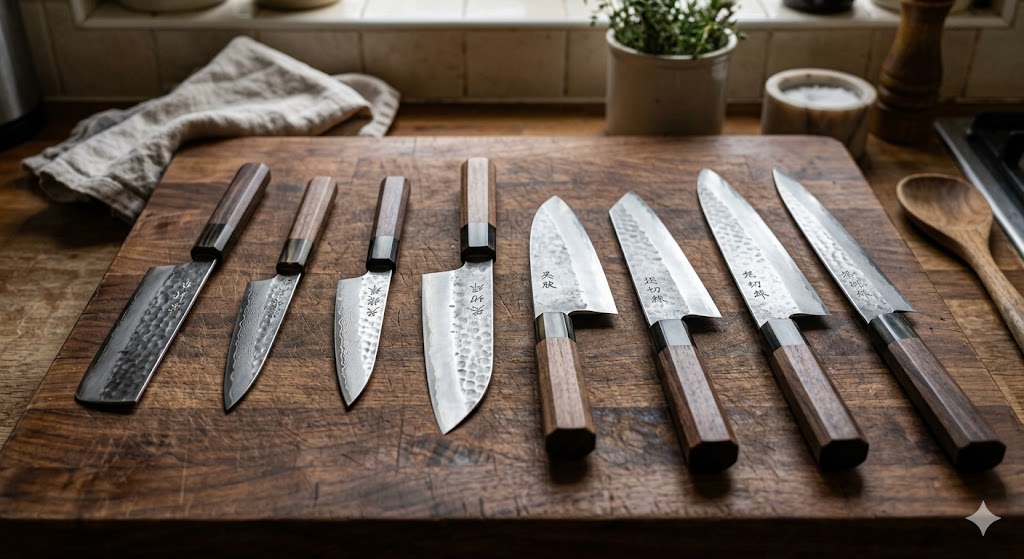
The gyuto (牛刀) is the Japanese version of the Western chef’s knife — the most versatile knife in the Japanese kitchen. Double-beveled, pointed, 18–27cm. Handles all general prep work: slicing, dicing, mincing. If you’re buying one Japanese knife, this is usually it.
Best for: Western-style cooking with Japanese steel precision. Protein, vegetables, herbs — everything.
Santoku — The Multi-Use Blade
The santoku (三徳, “three virtues”) is shorter than a gyuto (16–20cm), with a flat or gently curved edge and a sheepsfoot tip. The name refers to its mastery of three tasks: meat, fish, and vegetables. More approachable than a gyuto for some users due to its shorter length and flatter profile.
Best for: Home cooks, Japanese-style prep work, up-and-down chopping motion. More compact than a gyuto.
Nakiri — The Vegetable Knife
The nakiri (菜切り, “vegetable cutter”) has a rectangular blade with a flat edge — designed specifically for the straight up-and-down chopping motion used in Japanese vegetable prep. No rocking, no curved heel. Extremely effective for precise vegetable work.
Best for: Anyone who processes large quantities of vegetables. Excellent second knife after a gyuto or santoku.
Yanagiba — The Sashimi Slicer
The yanagiba (柳刃) is a long, single-bevel knife (24–33cm) designed for slicing fish into sashimi. The single bevel creates a precise angled cut that produces clean, presentation-quality slices. Requires specialized sharpening technique. Not a general-purpose knife — it excels at one thing and does nothing else well.
Best for: Home sushi enthusiasts, Japanese cooking specialists.
Deba — The Fish Butcher
The deba (出刃) is a thick, single-bevel knife used to break down whole fish — cutting through bones, removing heads, filleting. Heavy, robust, and specifically Japanese in design. Not suitable as a general kitchen knife; this is a specialty tool for fish preparation.
Best for: Serious fish cooks, whole-fish prep.
Petty Knife — Small Utility
The petty (ペティ, from the French “petit”) is a small utility knife (12–15cm) for detail work: peeling, trimming, small vegetables, fruit. The essential companion knife to a gyuto or santoku in a two-knife setup.
Steel Types: What to Know
Stainless Steel
Modern stainless alloys (VG-10, VG-MAX, AUS-8, SG2/R2, HAP-40) dominate the market. High-quality stainless blades harden to 60–65 HRC and maintain edge exceptionally well while being much more forgiving of moisture than carbon steel.
Key stainless grades:
- VG-10: The most common premium stainless in mid-range Japanese knives. Excellent value. Most Shun Classic and many Miyabi knives use VG-10.
- SG2 / R2: Powder metallurgy steel. Very high hardness (62–64 HRC), superb edge retention. Found in higher-end knives.
- HAP-40: High-speed steel with exceptional wear resistance. Elite tier.
Carbon Steel
Traditional Japanese knives used carbon steel (often white steel/shirogami or blue steel/aogami). Harder than most stainless, takes the finest edge possible, but reacts with acidic foods and requires immediate drying after use. Develops a protective patina over time but will rust if neglected.
Carbon steel is for experienced users who appreciate the sharpening tradition and don’t mind the maintenance requirements. It’s not beginner-friendly.
Damascus / Clad Construction
Many Japanese knives use a hard core (VG-10, SG2, etc.) clad with softer stainless Damascus layers. The Damascus visible pattern is a byproduct of the cladding construction — aesthetically beautiful, structurally functional (the softer outer layers protect the brittle hard core). Not just decoration.
Price Ranges
| Range | What to Expect | Representative Brands |
|---|---|---|
| Under $50 | Basic stainless, adequate but unremarkable edge retention | Generic, Tojiro entry-level |
| $50–$150 | Good stainless (VG-10 or equivalent), proper Japanese geometry | Tojiro DP, Global, Victorinox |
| $150–$350 | Premium stainless (VG-10, SG2), Damascus cladding, superior fit/finish | Shun Classic, Miyabi, Mac |
| $350–$700 | High-end stainless or carbon, artisan production, exceptional performance | Sakai Takayuki, Masamoto, Misono |
| $700+ | Named craftsman, collector grade, custom handles | Individual Sakai and Echizen smiths |
Handle Types: Wa vs Yo
Wa-handle (和柄): Traditional Japanese octagonal or D-shaped handle made from wood (often ho wood, magnolia) with a buffalo horn collar. Lightweight, precise, allows the hand to position naturally. The handle must be replaced if it loosens over years of use.
Yo-handle (洋柄): Western-style full-tang handle with rivets. More familiar to Western cooks. Heavier than wa-handle. Essentially maintenance-free. Found on “Western-influenced” Japanese knives.
Neither is inherently superior — it’s a personal preference and grip style question. Try both if possible before committing to a preference.
How to Choose Your First Japanese Knife
- Start with a gyuto or santoku — these handle 80% of kitchen tasks
- Choose stainless for your first knife — avoid carbon steel until you understand the maintenance requirements
- Set a real budget: The $80–$150 range provides genuinely excellent Japanese knives. Don’t buy the cheapest — the difference between $40 and $100 is significant. The difference between $200 and $600 is more marginal for most cooks.
- Buy a whetstone at the same time: A 1000/3000 grit combination whetstone is the correct tool for Japanese knife sharpening. Honing steels and pull-through sharpeners will damage Japanese blades.
Frequently Asked Questions
Should I buy a gyuto or santoku first?
If you’re primarily cooking Western-style food and are comfortable with a longer blade, choose a gyuto. If you cook a lot of Japanese food, prefer shorter knives, or use a push-cut (straight down) rather than rocking motion, choose a santoku. Both are excellent — it’s a grip and technique preference.
Can I put Japanese knives in the dishwasher?
Never. Dishwasher heat and detergents degrade wooden handles, corrode even stainless blades over time, and chip edges against other utensils. Hand wash only, immediate drying, and proper storage.
Do I need a knife block or magnetic strip?
A magnetic strip is preferred by many Japanese knife enthusiasts — it protects edges better than drawer storage and displays the knives safely. Knife blocks work fine as long as you insert and remove knives edge-up (or with a horizontal slot design) to avoid dulling the edge.
What cutting board should I use with Japanese knives?
Wood or end-grain wood boards are ideal. Hard plastic, glass, ceramic, and marble boards will damage Japanese knife edges quickly. Our Japanese cutting boards are specifically designed to be gentle on fine blades.
Browse our curated collection of Japanese kitchen knives and cutting boards at All Day I Eat Like a Shark.