Climate Change and Japanese Tea: How Tradition Meets Innovation
Japanese green
This isn’t a future problem. It’s a present one.
Why Tea Plants Are Particularly Sensitive to Climate
Camellia sinensis is not a robust, climate-tolerant crop. The world’s major
The flavor compounds that distinguish
- Cool temperatures during shaded growing periods maximize L-theanine accumulation (the umami-sweetness of gyokuro and matcha)
- Temperature differentials between day and night concentrate aroma compounds in mountain teas
- Specific post-harvest temperature patterns during processing determine the character of each style
When growing temperatures shift — even modestly — the chemistry shifts with them. A
How Climate Stress Affects the Tea Plant: The Biochemistry
| Stress Type | Physical Response | Chemical Impact on Flavor/Quality |
|---|---|---|
| Heat stress | Reduced photosynthesis, lower stomatal conductance, slowed growth | Increased catechins (more astringent), activated antioxidant pathways (SOD, POD), altered aroma profiles |
| Late spring frost | Cellular damage to tender early flush leaves, leaf browning and wilting | Destroyed amino acids and volatile compounds in the affected flush; total crop loss for that harvest |
| Summer drought | Stomatal closure to limit water loss, leaf shedding, thinner leaves | Increased osmotic compounds (proline, sugars); reduced overall yield and quality |
| Waterlogging | Root suffocation, nutrient uptake failure | Decreased synthesis of gallic acid and caffeine; off-flavors |
| Elevated CO₂ | Increased biomass and photosynthesis rate | Higher carbohydrate content, but lower amino acids and proteins — reduced umami, altered flavor balance |
The elevated CO₂ effect is particularly counterintuitive. More CO₂ means more photosynthesis and more biomass — plants can grow larger and produce more leaf. But it simultaneously reduces nitrogen-containing compounds including the amino acids (L-theanine is an amino acid) that give Japanese green
What’s Already Changing in Japan’s Tea Regions
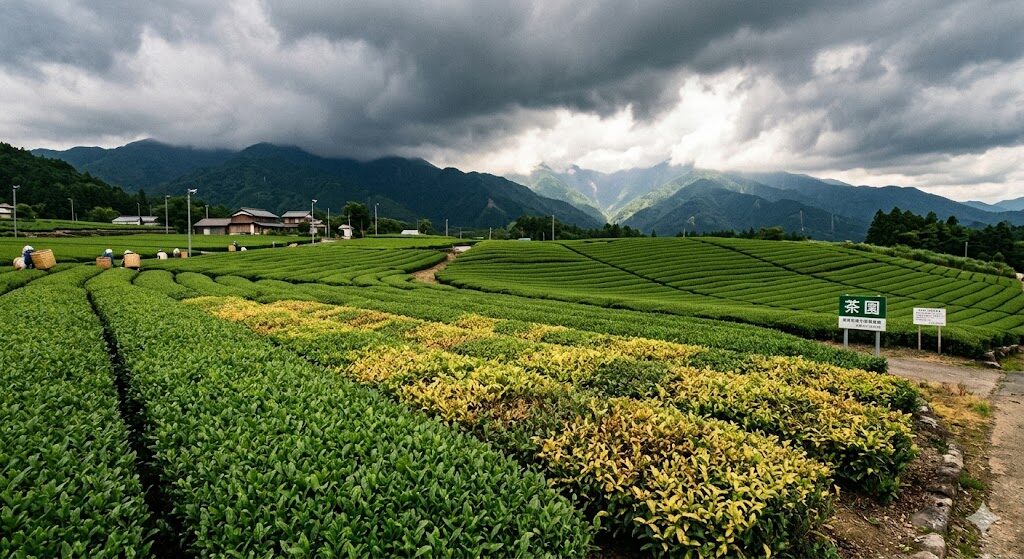
Shizuoka: Drought and the Deep-Steaming Response
Japan’s largest
Shizuoka’s most significant agricultural adaptation over the past 60 years — fukamushi (deep-steaming) processing — was originally developed to address a climate challenge.
Early Budding and Late Frost: The New Spring Rhythm
The effects of warming on first bud break (hatsuwa) are more complex than a simple shift earlier. While general warming can accelerate spring growth, warmer winters can actually delay budding for the first crop because
The first flush (ichiban-cha) is the highest-value harvest of the year. When a late frost kills tender first-flush leaves, farmers lose their most expensive crop in days. Anti-frost fans — large propeller-like devices installed on poles throughout
Uji and the Terroir Defense
Uji, the historical benchmark region for Japanese premium
Research centered on Uji has introduced the concept of ecosystem-based adaptation (EbA) as a response framework — using traditional agricultural knowledge and local biodiversity to maintain the specific conditions that define Uji
Kagoshima: A Growing Advantage With Limits
Japan’s southernmost major
Pest and Disease Pressure
Climate change affects not just the plant but the insects and fungi that attack it. Two dynamics are particularly significant for Japanese
Expanding Pest Ranges
Warmer winters allow pest populations to survive at higher latitudes and altitudes than previously possible. The
Integrated Pest Management (IPM) approaches are being extended across Japanese
Fungal Diseases
Blister blight (Exobasidium vexans) is a significant fungal disease that thrives in warm, moist conditions — precisely the conditions that climate change is intensifying in some
How the Chemistry of Japanese Tea is Changing
Beyond crop losses and pest pressure, the subtler chemistry of the leaf is shifting. Research tracking Japanese
- L-theanine decline: Higher temperatures during the growing season reduce L-theanine accumulation. This directly affects the umami profile that defines premium Japanese green teas. Long-term data from some Uji gardens shows measurable reduction in L-theanine concentrations in years with warm spring growing seasons.
- Catechin increase: Heat stress activates the plant’s antioxidant defense systems, increasing catechin production. More catechins mean more astringency. This shifts the flavor balance away from the sweet-savory profile of classic Japanese teas toward a sharper, more bitter character.
- Aroma volatilization: Delicate aroma compounds — particularly the cis-3-hexenal and other green-fresh volatiles that give first-flush sencha its characteristic freshness — are more temperature-sensitive than the catechin or amino acid fraction. These volatiles are among the first qualities to degrade in warm growing seasons.
The practical result is that the same cultivar, in the same garden, tended by the same farmer, is producing
Adaptation Strategies
Breeding for Climate Resilience
Cultivar development is the longest-term adaptation strategy and the one with the most potential. Japan’s
The challenge is the mismatch between breeding timelines and climate urgency. Developing and releasing a new cultivar takes 15–20 years from initial crossing to widespread distribution. Climate conditions are changing faster than breeding programs can respond. Marker-Assisted Selection (MAS) — using genetic markers to identify desirable traits without waiting for plants to mature — accelerates this process, but it’s still slower than the pace of change farmers are experiencing.
Shading and Microclimate Management
Shade management, traditionally used in gyokuro and matcha production to enhance flavor, is being reconsidered as a broader climate adaptation tool. Shade reduces soil and leaf temperature during heat events, maintains humidity, and — when using shade trees rather than synthetic materials — adds biodiversity that supports pest management. Some research programs are evaluating Chagusaba-style intercropping systems (where grass cuttings are used as mulch between
Elevation as Adaptation
One response is simply moving uphill. Higher-elevation
Technology
- Anti-frost fans: Standard in frost-vulnerable regions; mixing warmer air from above the frost layer with colder air near the canopy
- Irrigation systems: Drip irrigation for drought mitigation; sprinkler systems for frost protection via latent heat of ice formation
- Smart agricultural technology: Japan’s 2024 Smart Agricultural Technology Act promotes robotics and data-driven farming for labor efficiency — critical in an industry where the average farmer is over 65 and succession is uncertain
- Precision fermentation monitoring: Weather-responsive processing adjustments for
tea that experienced stress during growth
What This Means for Tea Drinkers
For consumers outside Japan, the implications of these changes show up in a few ways:
- Price increases for premium grades: First-flush losses from frost events, reduced L-theanine concentrations requiring selective purchasing from farms with optimal conditions, and higher production costs (frost protection, irrigation, IPM systems) all push prices up for the highest-quality material
- Flavor profile drift: Long-term buyers of specific farms or regions may notice gradual shifts in the flavor character of teas they’ve purchased for years — often a slight shift toward more astringency and less umami sweetness
- Regional character changes: The specific terroir advantage of individual regions may shift. Growing regions that performed well historically may decline; regions at the cooler edge of the current viable zone may improve
- Increased value of Chagusaba and certified heritage teas: Traditional cultivation methods that explicitly maintain specific microclimate conditions (the Chagusaba system is a UNESCO-recognized agricultural heritage) may represent a hedge against generic quality decline
Frequently Asked Questions
Is Japanese green tea quality declining because of climate change?
The picture is nuanced. For some farms and regions, measurable quality metrics (L-theanine concentration, aroma compound profiles) have declined in years with abnormal temperature patterns. For others, targeted adaptation — microclimate management, cultivar selection, precision processing — has maintained quality despite challenging conditions. The industry is not uniformly declining, but it is under significant stress that individual farmers are managing with varying success.
How does higher CO₂ affect tea quality?
Elevated atmospheric CO₂ increases photosynthesis and biomass production —
Which Japanese tea regions are most vulnerable?
Uji, because of its reliance on specific microclimate conditions (river fog, temperature differential) that define the flavor profile of its signature teas. Shizuoka, because of its combination of drought stress and late frost events. High-altitude gardens across multiple regions face compressed viable windows as temperature patterns shift. Kagoshima is initially less stressed but faces longer-term vulnerability from heat intensification and typhoon frequency.
What is the Chagusaba system and how does it help?
Chagusaba is a traditional Shizuoka practice where grass cut from nearby meadows is spread between
Can tea be grown in new regions as climate warms?
Yes, and this is already being studied. In Japan, higher elevations are becoming viable. More broadly,