Japanese Tea Brewing Science: Water Chemistry and Temperature
Tea is 99% water. That fact alone should tell you how much the water matters. But most people buying expensive Japanese sencha or gyokuro are brewing it in whatever comes out of their tap, which in many cities is hard, chlorinated, and not doing their
Understanding the basics of brewing science does not require a chemistry degree. It requires knowing three things: what temperature does, what mineral content does, and what pH does. Everything else in
Temperature: The Extraction Rate Controller
Water temperature controls how quickly and completely different
What extracts at what temperature:
L-theanine and free amino acids are highly water-soluble and extract readily at all temperatures, including cold. You can pull L-theanine out of
Catechins (EGCG, ECG, and related polyphenols) are more temperature-dependent. At 60°C, catechin extraction is modest and slow. At 80°C, it accelerates significantly. At 90 to 100°C, catechins extract aggressively and quickly.
Caffeine falls in the middle — it extracts faster at higher temperatures but has reasonable solubility across the temperature range. Cold brew still extracts meaningful caffeine, just less than hot brew.
The practical implication: Lower temperature = more amino acid sweetness relative to catechin bitterness. This is not about “less extraction” — it is about selective extraction. You are choosing which compounds to favor. For most Japanese green teas, this means targeting temperatures where amino acids dominate and catechins are controlled.
Water Hardness: Why Mineral Content Matters
Water hardness is measured by dissolved mineral concentration — primarily calcium and magnesium carbonate. Soft water has low mineral content; hard water has high mineral content.
Japan has naturally soft water in most
What hard water does to Japanese green
Calcium and magnesium ions interact with
Hard water also affects the green color. Calcium carbonate shifts the pH toward alkaline, which can dull the vibrant green of Japanese
Practical guidance:
- If your tap water is hard (above 150 ppm TDS or 100 mg/L hardness), use filtered or soft bottled water for your best Japanese teas
- A basic activated carbon filter removes chlorine and some minerals
- Reverse osmosis produces ultra-pure water that may actually be too soft for some teas — you can blend with a small amount of tap water to add back minimal minerals
- Japanese spring waters like Volvic (soft, low mineral) work well for Japanese
tea
Chlorine and Its Effect on Tea Flavor
Municipal tap water is chlorinated for disinfection. Chlorine (and chloramine in some municipalities) has a significant impact on
Chlorine is volatile — it evaporates with heat. Boiling tap water for several minutes drives off most free chlorine. However, chloramine (increasingly used as a more stable disinfectant) does not evaporate with boiling. It requires activated carbon filtration to remove.
The impact: chlorine and chloramine interact with
pH: Acidity and Alkalinity in Brewing Water
The pH of brewing water affects
Slightly acidic water (pH 5.5 to 7.0): Tends to produce brighter, more vibrant green
Neutral water (around 7.0): Generally the sweet spot for most Japanese greens. Neutral pH allows full flavor development without the distortion that extreme acidity or alkalinity creates.
Alkaline water (pH above 7.5): Problematic for Japanese green
Hard water tends to be alkaline (calcium carbonate raises pH). Soft water and filtered water tend toward neutral to slightly acidic. This is another reason soft water is better for Japanese green
The Ideal Water for Japanese Tea : Practical Targets
TDS (total dissolved solids): 30 to 80 ppm is ideal for Japanese green
Hardness: Below 80 mg/L (as calcium carbonate). Soft to moderately soft.
pH: 6.5 to 7.5. Slightly acidic to neutral.
Chlorine/Chloramine: None ideally. Use filtered water or let boiled water stand if you suspect high chlorine.
You do not need to test your water to brew good
Putting It Together: The Optimal Brewing Setup
For everyday good Japanese
- Use filtered tap water or a reasonably soft, low-mineral bottled water
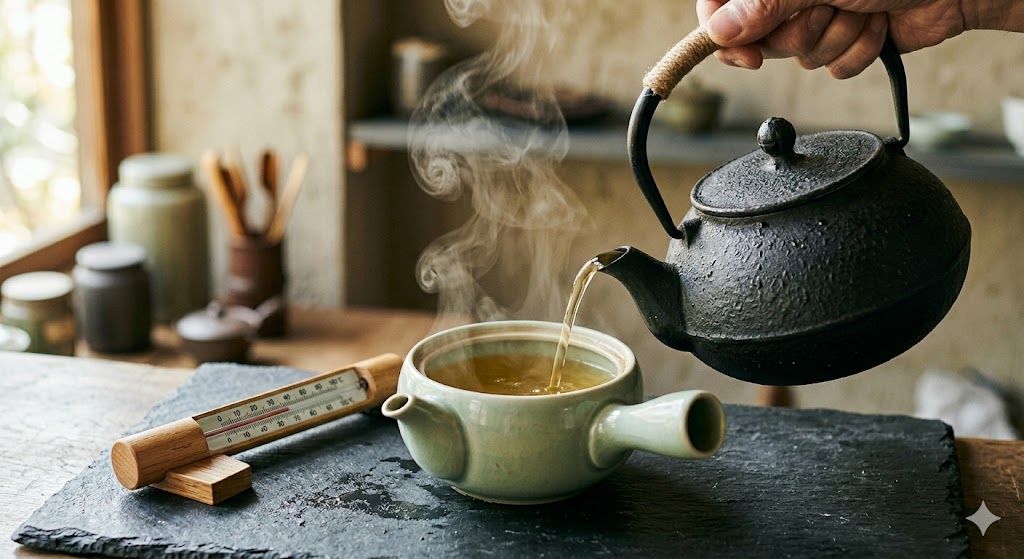
- Use a temperature-controlled kettle to hit target temperatures (or an instant-read thermometer)
- Let just-boiled water cool before using for green teas — never pour boiling water on premium sencha or gyokuro
- Brew in a vessel that retains temperature well (ceramic kyusu rather than glass)
For the highest-quality Japanese teas (gyokuro, premium first-flush sencha):
- Use Volvic or similar low-mineral European spring water, or filtered water tested below 80 ppm
- Temperature-controlled kettle is essentially required for gyokuro brewing accuracy
- Pre-warm your kyusu and cups with hot water before brewing — this prevents the first pour from losing excessive heat to the cold vessel
Frequently Asked Questions
Does filtered water really make a noticeable difference for Japanese tea ?
In hard-water areas, yes — the difference can be dramatic. In soft-water areas with clean municipal water, the difference is more subtle. The biggest gains come from filtering out chlorine and chloramine, which affect aroma significantly in delicate teas.
Can I use mineral water for Japanese tea ?
It depends on the mineral content. High-mineral water (Evian, Perrier) is too hard for Japanese green
Is alkaline water better for tea ?
No. Alkaline water marketed as “healthy” (pH 8 to 9) degrades the green color of Japanese
Why does my gyokuro taste bitter even at 60°C?
Possible causes: water too hard (mineral interference), steeping too long, too much leaf, or the gyokuro itself is not high quality. At 60 to 70°C with soft water and a 60 to 90 second steep, well-made gyokuro should have minimal bitterness. Test your water temperature with a thermometer — many people overestimate how cool their “cool” water actually is.
How does cold brew relate to brewing science?
Cold brew is selective extraction by temperature. At 5 to 15°C, amino acids extract well over 1 to 2 hours while catechin extraction is dramatically suppressed. The resulting