Best Japanese Knives for Home Cooks 2025
Japanese knives have earned their reputation. They’re thinner, harder, and sharper than most Western alternatives — and when matched to the right cutting board and care routine, they stay sharper for longer. But the range of options can be overwhelming. This guide focuses specifically on the home cook: practical knives that perform at the highest level without requiring professional knife skills to maintain.
Why Japanese Knives Are Different
Japanese knives are made from harder steel — typically in the 60–67 HRC range on the Rockwell hardness scale, compared to 55–58 HRC for most European knives. Harder steel holds a sharper edge longer, but it’s also more brittle and can chip if used on frozen food, bones, or hard vegetables like butternut squash with a twisting motion.
The geometry is also different. Japanese knives use a thinner blade with a smaller bevel angle, which means they slide through food with less resistance. This is the difference you feel on the first slice — a quality Japanese knife feels almost effortless compared to a thick Western blade.
Most Japanese knives sold to home cooks are double-bevel (sharpened on both sides), which means no additional technique adjustment is needed. Single-bevel knives (like yanagiba and deba) are for specific techniques and aren’t recommended as first knives.
The Best Starting Knives for Home Cooks
Santoku: The All-Purpose First Choice
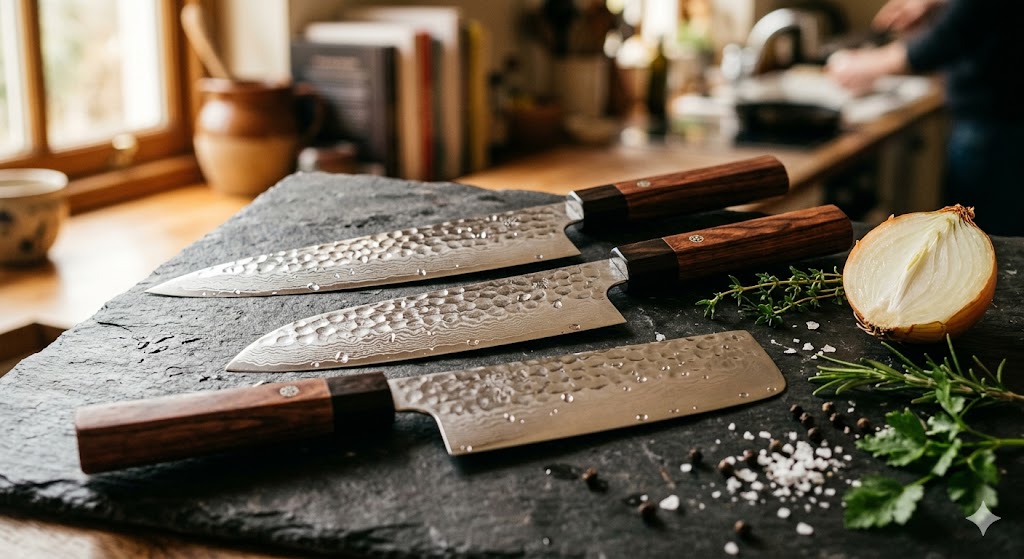
The santoku (literally “three virtues” — meat, fish, vegetables) is the most versatile Japanese knife for home cooking. The shorter length (typically 165–180mm) and slightly more rounded tip make it less intimidating than a long gyuto, and the blade geometry excels at the up-and-down chopping motion most home cooks use naturally.
Best for: Vegetables, boneless proteins, daily prep work. The santoku handles 80% of home kitchen tasks effectively.
What to look for: A santoku in VG-10 or AUS-10 steel at 165–180mm. These stainless steels are hard enough to hold an edge but forgiving enough not to chip with normal use. Avoid ultra-hard steels (67+ HRC) as your first knife.
Gyuto: The Japanese Chef’s Knife
The gyuto is Japan’s equivalent of the Western chef’s knife — longer (210–240mm for home use), with a curved belly for the rocking motion and a more tapered tip. If you already use a Western chef’s knife and are comfortable with the motion, the gyuto is the natural Japanese parallel.
Best for: Slicing proteins, longer vegetable prep, anything where length and tip precision matter. The gyuto has a higher ceiling than the santoku for skilled cooks but requires slightly more technique.
Nakiri: The Vegetable Specialist
The nakiri has a thin, rectangular blade designed exclusively for vegetables. The flat edge contacts the board completely on each downstroke — no curved belly, no rocking. This produces clean, even cuts with minimum effort. For Japanese cooking’s fine vegetable work (paper-thin daikon, julienned carrots, precise cucumber slices), the nakiri is the right tool.
Best for: Any vegetable-forward cooking, Japanese or otherwise. If you make salads, stir-fries, and vegetable-heavy dishes daily, the nakiri earns its place quickly.
Petty Knife: The Compact Multi-Tool
A petty knife (120–150mm) is Japan’s answer to a Western paring knife, but longer and more versatile. It handles detail work, small ingredients, and precision cutting where a full chef’s knife is too large. Many cooks find a petty more useful than a paring knife because the added length enables more technique.
Steel Types: What Actually Matters
VG-10 stainless: The most popular steel for quality home cook knives. Hard enough for excellent edge retention, stainless so rust isn’t a concern, and forgiving enough not to chip with normal use. Brands like Shun, Miyabi, and many Japanese makers use VG-10 as their standard.
AUS-10 stainless: Similar profile to VG-10 with slightly different trace elements. Excellent for the same reasons. Often found in more affordable quality knives.
Blue/White Steel (Aogami/Shirogami): High-carbon steel, not stainless. Achieves exceptional sharpness and takes an incredible edge. Requires more care — must be dried and occasionally oiled to prevent rust. Recommended once you’re comfortable with knife maintenance.
Damascus steel: A layered pattern that’s primarily aesthetic. The performance comes from the core steel, not the pattern. Don’t pay a premium for Damascus unless the core steel specs justify it.
Handle Styles
Western (yo) handles: Full tang, riveted construction, similar to Western knife handles. More familiar feel, heavier, better balanced for rocking cuts. Most Japanese knives sold internationally use Western handles.
Japanese (wa) handles: Octagonal or D-shaped, typically in wood or buffalo horn, with a hidden tang. Lighter, more agile, traditional Japanese feel. Preferred by many serious cooks once they’ve adjusted to the grip.
Care for Japanese Knives
The harder steel that makes Japanese knives sharper also makes them more demanding of their cutting surface:
- Use a hinoki or end-grain hardwood board only. Remove “plastic” from the list of damaging materials. The Musashi source explicitly states: *”We recommend buying a plastic and/or wooden cutting board to protect your knife… Because the materials are softer, and therefore easier on the knife’s edge”* [27]. *(Note: The article’s FAQ section also tells users to “Avoid… hard plastic” [34]. To align with the research, it is best to clarify that standard plastic boards are generally considered safe and recommended for edge retention.)*
- Hand wash and dry immediately. No dishwasher — the heat cycles and detergent damage both the blade and handle.
- Sharpen with whetstones, not pull-through sharpeners. Pull-through sharpeners remove too much metal and can damage the thin Japanese bevel.
- Use for intended tasks only. No bones, no frozen food, no using the spine to crack shellfish. Japanese knives are precision tools, not cleavers.
Browse our knife and cutting board selection at shop.alldayieat.com/product/japanese-knives/.
Frequently Asked Questions
- Should a beginner start with a santoku or gyuto?
- Santoku. The shorter length, rounded tip, and up-and-down cutting motion is more intuitive for most home cooks. The gyuto is better for experienced cooks who already use the rocking motion naturally and want to transition to a Japanese equivalent.
- Why are Japanese knives so much more expensive than Western ones?
- High-quality Japanese knives involve more hand labor, harder and more expensive steel, and a manufacturing tradition with extremely high quality standards. A $150 Japanese knife will significantly outperform a $50 Western knife in sharpness and edge retention. But the $150 Japanese knife also demands more careful use and maintenance to deliver that performance.
- What cutting board do I need for Japanese knives?
- Hinoki (Japanese cypress), end-grain maple, or end-grain walnut. Avoid bamboo, glass, ceramic, and hard plastic. The blade hardness that makes Japanese knives excellent also makes them prone to edge damage on hard surfaces. A softer wooden board is non-negotiable for preserving a Japanese knife edge.
- How often do Japanese knives need sharpening?
- With regular home use and a proper cutting board, a good Japanese knife in VG-10 steel needs sharpening every 2–4 months. More frequent light stropping on a leather strop or fine ceramic rod extends the time between full sharpening sessions significantly.
- Is a $50 Japanese knife worth buying?
- There are some solid options at $50–$80 in AUS-8 or similar steels — these are genuinely better than most Western knives in the same range. The step up to VG-10 at $100–$150 is significant. Under $50, quality is inconsistent, and you may end up with a knife that’s hard to sharpen and holds an edge poorly.