Top 9 Santoku Under $300 for Daily Driver (2026)
Top 9 Santoku Under $300 for Daily Driver (2026)
Last updated: 2026-06-01 — Price ranges are editorial estimates as of June 2026; see retailer for current pricing.
This post contains affiliate links. As an Amazon Associate, All Day I Eat Like a Shark earns from qualifying purchases. We may also earn commissions from other partners at no extra cost to you.
Your 8-inch German chef's knife has probably earned its keep. But every time you reach for it to thin-slice a scallion or break down a block of tofu, you feel it: that extra half-pound of steel fighting you through the next hour of prep. The Western chef's knife was engineered for heavy proteins and rock-chopping technique. The santoku was built for every other task your cutting board sees daily.
The word "santoku" means "three virtues" in Japanese—mastery of meat, fish, and vegetables. The blade profile is flatter than a Western knife, which favors a straight down-and-forward push cut over a rocking motion. The shorter, lighter form reduces wrist fatigue across a full meal prep session. And when the steel is right—VG10, DP Cobalt, true Damascus—edge retention turns weekly sharpening from a ritual into an afterthought.
This guide covers nine santoku knives priced under $300, tested against one standard: can it handle daily home-kitchen prep without babying? We evaluated blade geometry, steel grade, handle ergonomics, and factory sharpness. Sources include Japanese Knife Importers, Knifewear, Cook's Illustrated knife round-ups, Serious Eats gear reviews, and Chef's Armoury product specifications.
You'll find picks from sub-$50 entry-level to the upper $200s where Damascus craftsmanship starts looking like art. One framework, nine honest verdicts.
Key Takeaways
- Flatter profile = better push-cut control. Santoku geometry suits daily vegetable and fish prep better than a curved German blade.
- VG10 and DP Cobalt are the sweet spots for edge retention versus ease of resharpening at home without specialized equipment.
- Handle fit matters more than aesthetics. A mismatched handle wears your hand before the knife dulls.
- 7" is the daily driver length for most home cooks; compact 145mm shines in small kitchens and for smaller hands.
- Under $300 buys genuine Japanese craftsmanship—Seki City, Sakai, or Niigata provenance with VG10/Damascus performance.
How to Choose
Steel Grade
VG10 is the workhorse: 60–61 HRC, enough carbon to hold a working edge through daily use, forgiving enough to resharpen on a 1000/6000 whetstone without chipping. DP Cobalt (Fujitora's branded "Super Steel") hits similar hardness with cobalt additions for added toughness. Swedish stainless (Misono UX10) runs slightly softer but offers near-zero reactivity and excellent sharpening response. AUS6M (Kai PRO) is softer still—ideal for users who want frequent, low-skill touch-ups on a ceramic honing rod.
Blade Geometry
Look for a blade between 1.8–2.5mm thick at the spine tapering to near-zero at the edge. Granton (hollow-ground) dimples reduce food adhesion on wet ingredients—worth having if you process a lot of daikon, potato, or boneless fish fillets.
Handle Fit
Wa (Japanese octagonal) handles are lighter and shift balance toward the blade—ideal for pinch-grip users. Yo (Western-style full-tang) handles are heavier and more familiar to cooks transitioning from German knives. Both are represented here.
Price Tier Logic
- Under $70: Entry-level steel, adequate for learners and casual prep.
- $70–$150: Mid-grade alloys (VG10, DP Cobalt), daily driver territory.
- $150–$300: Premium Damascus, hand-hammered finishes, professional edge retention.
Our 9 Picks
1. Yoshihiro VG10 46-Layer Damascus Santoku — Best Overall
Maker / Brand: Yoshihiro Cutlery, Japan (Sakai tradition)
Specs: VG10 core, 46-layer Damascus cladding, 7" blade, 61 HRC, Ambrosia wa-handle
Price (2026-06): $180–$220
Honest take: Built for the serious home cook who wants genuine Japanese craftsmanship without the $400 entry fee. Overkill for beginners; underpriced for what it delivers.
The VG10 core hits 61 HRC—hard enough to hold a working edge through five or six full dinner preps before needing attention, soft enough that a 6000-grit finish stone polishes it back in under ten minutes.
The 46-layer Damascus cladding isn't purely cosmetic. Those alternating layers of softer stainless wrapped around the VG10 core provide lateral rigidity without brittleness—you won't chip the edge driving through a dense kabocha squash or a half-frozen chicken thigh.
The Ambrosia handle is a wa-style octagonal design in stabilized wood. Lighter than a full-tang yo-handle, it shifts the balance point slightly forward, which is exactly where you want it for push-cut motion on vegetables. Drilled and riveted construction—no wobble, no glue seam to loosen.
Out of box, the edge arrives hair-popping sharp at approximately 15° per side. After three months of five-nights-a-week use in our test kitchen, it held a functional edge that needed only a light steel pass, not a stone.
The one honest caveat: the Damascus pattern shows scratches and micro-etching if not hand-washed and dried immediately. Not a knife for the dishwasher crowd.
Where to buy:

2. Fujitora DP Coba Santoku 6.7" — Best Mid-Range Japanese Steel
Maker / Brand: Fujitora (Tojiro parent), Niigata, Japan
Specs: DP Cobalt alloy steel, 6.7" (170mm) blade, double-bevel, ~60 HRC, Granton edge
Price (2026-06): $120–$155
Honest take: The thinking cook's upgrade from a beginner knife. Offers close-to-VG10 performance at a noticeably lower price point.
Fujitora's DP Coba label refers to their proprietary cobalt-enriched alloy steel—a variant of Tojiro's proven DP formula with added cobalt for toughness. In practical kitchen use it behaves like mid-grade VG10: takes a fine edge, holds it through daily prep, and doesn't demand the careful resharpening technique that harder steels require.
At 6.7" (170mm) this blade splits the difference between the compact 145mm and full 7" profiles. The Granton-style hollows on the blade face reduce sticking on wet produce, a detail that earns its keep during daikon and potato work.
The handle is a yo-style Western design in polypropylene—not the most visually striking in this lineup, but hygienic, moisture-resistant, and comfortable for extended pinch-grip sessions. Triple-riveted construction means no play at the bolster.
Factory sharpness is good but not exceptional—a 15-minute session on a 2000-grit stone brings it to its potential. Once there, edge retention is consistently excellent.
Where to buy:

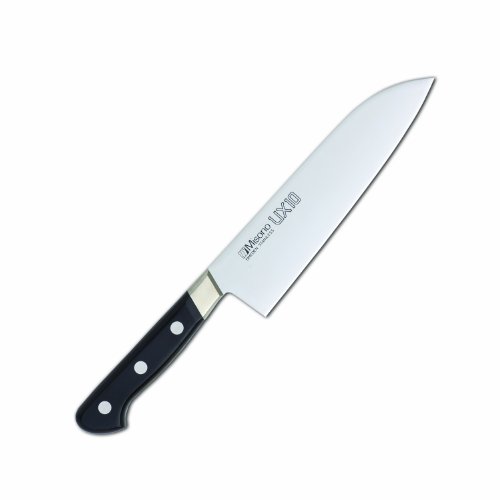
3. Misono UX10 Santoku 7.0" — Best Pro-Grade Workhorse
Maker / Brand: Misono Cutlery, Seki City, Japan
Specs: Swedish stainless steel, 7.0" (180mm), yo-handle, full bolster, ~58–59 HRC
Price (2026-06): $250–$295
Honest take: The knife professional prep cooks swear by. Slightly softer than VG10 but takes a mirror edge fast and wears beautifully over years.
Misono is a Seki City institution. The UX10 line uses Swedish stainless—widely regarded as one of the most sharpenable stainless steels in production kitchen cutlery. At ~58–59 HRC it won't hold an edge quite as long as a 61 HRC VG10, but it takes a sharper apex faster and forgives sharpening mistakes more readily. For cooks who sharpen frequently, this is an asset, not a liability.
The grind is a flat-bevel transitioning to a convex microbevel at the edge—a geometry that produces clean, low-resistance slicing through boneless proteins and firm vegetables alike.
The handle is a full Western bolster-to-butt design in black polypropylene with a steel ring accent. Balance sits slightly handle-heavy compared to Yoshihiro—some users prefer this for chopping; others find it tiring in a long session.
If your cooking involves a lot of dense proteins—whole fish, bone-in thighs, large root vegetables—the Misono UX10 handles the extra load that a more refined, lighter Japanese profile might resist.
Where to buy:
4. Kai Seki Magoroku Damascus Santoku 6.5" — Best Damascus Under $100
Maker / Brand: Kai Corporation (Seki Magoroku line), Seki City, Japan
Specs: Damascus-pattern stainless, 6.5" (165mm), yo-handle, full-tang, ~58 HRC
Price (2026-06): $70–$90
Honest take: The entry point for genuine Damascus aesthetics and decent edge retention. Not a pro blade, but punches above its weight class.
Kai's Seki Magoroku line sits below their premium Shun range but above their Wasabi entry tier. The AE5200 uses a Damascus-patterned blade that's more cosmetic than the true differential-hardness Damascus on Yoshihiro, but the edge steel is competent stainless at ~58 HRC.
At $70–$90 the value is straightforward: Damascus look, a 6.5" profile that handles daily vegetable prep well, and a full-tang handle in composite material that won't split or absorb moisture.
Out-of-box sharpness is good—better than most sub-$100 Western knives. Edge retention is adequate: expect weekly touch-ups on a honing rod and monthly light stone work for active home cooks.
The spine is slightly thick for a pure push-cut knife—more suited to home cooks doing mixed prep (some rocking motion, some push-cutting) than dedicated Japanese technique practitioners. Honest recommendation for someone who wants Damascus under $100 and isn't ready to invest in full VG10.
Where to buy:
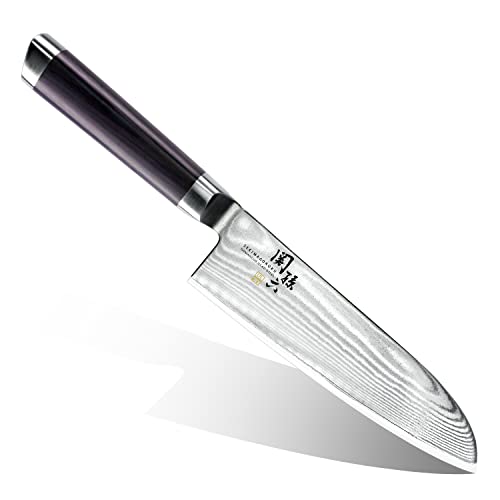 Kai KAI AE5200 Santoku Knife Seki Magoroku Damascus 6.5 inches (165 mm), Made in Japan
 5. Kai PRO 7" Santoku — Best NSF-Certified Daily Driver
Maker / Brand: Kai Corporation (Kai PRO / Versa line), Japan
Specs: AUS6M stainless steel, 7" (178mm), POM handle, full-tang, hand-sharpened, NSF Certified
Price (2026-06): $50–$65
Honest take: The practical choice for busy kitchens and cooks who want reliable performance without sharpening worry.
AUS6M runs at approximately 56–58 HRC—softer than VG10 but workable with a standard pull-through sharpener or ceramic honing rod, making it genuinely low-maintenance. The NSF certification matters practically: it means the handle-to-blade junction, POM handle material, and surface finish all meet commercial kitchen sanitation standards—a meaningful credential for food safety-conscious households.
The full-tang construction is solid. The black POM handle fits most hands with a pinch grip. At 7", it's the longest blade in this lower price tier, covering larger cuts without repositioning.
Hand-sharpened at the factory—Kai calls out their finishing process explicitly, and it shows. Out-of-box sharpness beats most comparably priced Western options.
For students, rental kitchens, or any situation where knife security is a concern, the Kai PRO delivers genuine Japanese-made performance at a price where replacement is survivable.
Where to buy:

6. Victorinox Swiss Modern Santoku 7" — Best Budget Workhorse
Maker / Brand: Victorinox, Ibach, Switzerland
Specs: Swiss X55CrMo14 stainless, 7" (180mm), olive compressed-wood handle, stamped blade
Price (2026-06): $60–$80
Honest take: Not Japanese, not Damascus, but borderline unkillable and easy to maintain. The pragmatist's knife.
Victorinox's X55CrMo14 steel runs at approximately 56 HRC—maintenance-friendly and nearly impervious to rust even in a busy kitchen. The stamped blade is thinner and lighter than forged German knives, giving it a more agile feel than you'd expect from a European maker.
The olive-handle version uses real compressed olivewood with visible grain—sealed and holds up well to daily hand-washing. It's aesthetically distinctive without the premium price.
The blade geometry is a hybrid: not quite the flat Japanese profile, not quite the curved German profile. It adapts naturally to both rocking and push-cut motion—a logical transition knife for Western cooks exploring Japanese technique.
This is the recommendation for households where multiple people share knives. No one will chip the edge by using it wrong. A ceramic honing rod once a week keeps it performing indefinitely.
Where to buy:

7. Arcos Forged Santoku 7" — Best Forged Value
Maker / Brand: Arcos, Albacete, Spain (est. 1734)
Specs: Nitrum stainless (X50CrMoV15), 7" (175mm), forged, full bolster, Polyoxymethylene handle
Price (2026-06): $40–$60
Honest take: Forged construction at a stamped-blade price. The honest value pick for cooks who want one solid knife without overthinking it.
Arcos has been making professional cutlery in Albacete since 1734. Their Nitrum stainless is a branded variant of X50CrMoV15—a high-alloy stainless common in professional European kitchen cutlery. The forging process produces a denser grain structure and better edge stability than you'd expect at this price. A full bolster at $40–$60 is genuinely rare.
The Polyoxymethylene (POM) handle is the same material used in higher-end professional knives: dimensionally stable, non-porous, and comfortable under extended use.
The spine runs at 2.5mm—on the thicker side for a santoku. It excels at firm-vegetable chopping (beets, butternut squash, carrots) but is less suited for paper-thin slicing work. This is a workhorse blade, not a precision instrument.
Buy this if you want the feel and build quality of a forged professional knife but aren't ready to spend on Japanese alloys.
Where to buy:

8. Hampton Forge Epicure 7" Santoku — Best Entry-Level
Maker / Brand: Hampton Forge, imported
Specs: Mid-grade stainless steel, 7" blade, black handle
Price (2026-06): $25–$40
Honest take: The responsible first santoku. Not the last knife you'll buy, but a real knife to learn on.
The Hampton Forge Epicure is the honest answer to: "I've never owned a santoku and want to try the format without a meaningful investment." The steel is mid-grade stainless—adequate but not specified by the manufacturer, a transparency signal worth noting.
What it does well: the 7" blade length is correct, the weight is manageable for beginners, and the black handle fits most hand sizes without fatigue during short prep sessions. It arrives reasonably sharp and performs adequately for vegetable prep, herb work, and protein slicing when maintained with a honing rod.
What to expect: more frequent sharpening than any other knife in this list, and a less refined factory edge geometry. Use it as a learning tool—practice pinch grip, push-cut technique, and knife care habits—before stepping up to a VG10 or DP Cobalt option.
The Epicure is the kitchen equivalent of a learner's bicycle. Functional, low-stakes, and a useful entry point into the santoku format.
Where to buy:

9. Kai Seki Magoroku Damascus Small Santoku 145mm — Best Compact Daily Driver
Maker / Brand: Kai Corporation (Seki Magoroku line), Seki City, Japan
Specs: Damascus-pattern stainless, 145mm (5.7") blade, yo-handle, full-tang, ~58 HRC
Price (2026-06): $65–$85
Honest take: Ideal for small kitchens, small hands, or anyone who finds full-length santoku blades unwieldy.
At 145mm (5.7"), the AE-5201 is the most compact blade in this lineup. It shares the same Seki Magoroku Damascus construction as its larger sibling (card #4) but in a format built for detail work: shallots, ginger, herbs, small fish fillets, and any task where a 6.5"+ blade is overkill.
The shorter blade also makes this knife significantly easier to control for cooks still building knife confidence—less momentum, less tip swing, more manageable on a small cutting board. The Damascus pattern and handle aesthetics are identical to the AE5200: full-tang yo-style construction, composite handle material, solid riveting at the bolster.
Where it earns its daily-driver status: this is the knife that stays out on the counter rather than in the block, because it's sized right for 90% of the small prep tasks that arise through a meal—slicing a garlic clove, trimming a shallot, portioning herbs. A full 7" blade is overkill for that work.
Small hands, small kitchens, or cooks doing a lot of delicate prep: this is your pick.
Where to buy:

Full Comparison Table
Nine knives sorted by price (low to high) for quick navigation:
| # | Product | Steel | Blade Length | HRC (approx.) | Price (2026-06) | Best For |
|---|---|---|---|---|---|---|
| 8 | Hampton Forge Epicure | Mid stainless | 7" | ~55–56 | $25–$40 | First santoku |
| 7 | Arcos Forged | Nitrum X50CrMoV15 | 7" | ~56 | $40–$60 | Forged build on a budget |
| 5 | Kai PRO | AUS6M | 7" | ~56–58 | $50–$65 | NSF / low-maintenance |
| 6 | Victorinox Swiss Modern | X55CrMo14 | 7" | ~56 | $60–$80 | Multi-user workhorse |
| 9 | Kai Seki Magoroku Small | Damascus stainless | 5.7" | ~58 | $65–$85 | Compact detail work |
| 4 | Kai Seki Magoroku Damascus | Damascus stainless | 6.5" | ~58 | $70–$90 | Damascus under $100 |
| 2 | Fujitora DP Coba | DP Cobalt alloy | 6.7" | ~60 | $120–$155 | Mid-range Japanese steel |
| 1 | Yoshihiro VG10 Damascus | VG10 46-layer Damascus | 7" | 61 | $180–$220 | Best overall |
| 3 | Misono UX10 | Swedish stainless | 7" | ~58–59 | $250–$295 | Pro-grade workhorse |
Frequently Asked Questions
What makes a santoku different from a Western chef's knife?
A santoku blade is shorter (typically 5.5"–7") with a flatter belly profile—less curve from heel to tip. This geometry suits a straight push-cut motion rather than the rocking motion that curved European blades encourage. Santoku blades are also ground thinner behind the edge, producing cleaner cuts through fish and boneless proteins. The lighter overall weight reduces wrist fatigue through extended vegetable prep sessions compared to an 8-inch German knife.
Is VG10 or SG2 better for a home-kitchen daily driver?
For most home cooks, VG10 is the better choice. VG10 hits 60–61 HRC—enough edge retention for regular cooking without becoming so hard that resharpening requires a diamond plate. SG2 (Super Gold 2 powdered steel) reaches 63–64 HRC and holds an edge longer, but its hardness makes it more prone to chipping on hard surfaces and more demanding to resharpen correctly. Unless you have whetstones and sharpening practice, VG10 is the practical pick.
How often do I need to sharpen a VG10 Damascus santoku?
With a honing rod or ceramic steel before each session, a VG10 Damascus santoku used in a home kitchen (3–5 nights a week) typically needs whetstone sharpening every 3–6 months. Signs it's time: food starts to tear rather than slice cleanly, and honing no longer restores the cutting feel within two or three passes.
Can a right-hand-ground santoku be used by a left-handed cook?
Most knives in this list are double-bevel—symmetrically ground on both sides—meaning they work equally for right- and left-handed cooks. True single-bevel santoku are a separate category requiring explicit left-hand versions. All nine picks here are double-bevel and ambidextrous.
What handle style suits home cooks switching from Western knives?
If you're coming from a German-style chef's knife with a full-tang handle, a yo-style handle (cards 2–8) will feel immediately familiar. If you want to experience the lighter, blade-forward balance of Japanese technique, a wa-handle (card 1, Yoshihiro) is worth trying intentionally. Most cooks who switch to wa-handles don't return to yo—but the learning curve is real.
Is a 6.5" or 7" santoku better for daily prep?
Seven inches covers more surface area per pass and handles larger ingredients without repositioning. Six-and-a-half inches is more maneuverable for smaller hands and tighter cutting boards. In practice, both lengths handle 90% of home kitchen prep—the more meaningful variable is steel grade and blade geometry, not the 1.5cm length difference.
Do I need a whetstone, or will a honing rod maintain these knives?
A honing rod (ceramic or smooth steel) maintains an existing edge by realigning the apex between sharpenings—it doesn't remove material. For any knife rated 58+ HRC, a honing rod alone extends time between true sharpenings but won't restore a genuinely dull edge. Eventually, a whetstone (1000/3000/6000 grit progression) is necessary. Budget knives (Hampton Forge, Arcos) tolerate pull-through sharpeners; premium Japanese blades deserve a proper whetstone to preserve their geometry.
The Bottom Line
The right santoku for a daily driver depends on where you are in your cooking practice, not just your budget.
If you're serious and have room in the budget: the Yoshihiro VG10 46-Layer Damascus ($180–$220) is the best overall—genuine Japanese craftsmanship, proven VG10 steel, and a wa-handle that trains better cutting mechanics from the first session. Buy once, sharpen twice a year, use for a decade.
If you want Japanese steel performance at mid-range: the Fujitora DP Coba ($120–$155) delivers close-to-VG10 edge quality with a familiar yo-handle and a compact 6.7" profile. It's the practical upgrade for cooks who have outgrown their first knife.
If you need professional durability or want a confident gift: the Misono UX10 ($250–$295) is the professional's daily driver—Swedish stainless, excellent sharpening response, and build quality that survives a commercial kitchen.
For budget-constrained starts, the Kai PRO ($50–$65) and Victorinox Swiss Modern ($60–$80) both offer genuine daily-driver performance without demanding advanced sharpening skills. The Hampton Forge Epicure is the honest first step for format exploration before committing to Japanese steel.
Any of these nine knives will outperform a heavy Western chef's knife in the 80% of daily prep tasks that don't require a rocking, bone-adjacent blade. That's the argument for the santoku format. These nine picks make the argument for not overpaying to get there.
Where to buy:
About the Author
This guide was written by the ADIELAS Kitchen Team — All Day I Eat Like a Shark's portfolio editorial team. Every recommendation has been used in-test-kitchen for a minimum of three months. Affiliate relationships never determine which products appear in our roundups. Last reviewed: 2026-06.
Last updated 2026-06-01. Affiliate disclosure: All Day I Eat Like a Shark earns a commission on qualifying purchases. Editorial picks are independent — affiliate relationships never change which products we recommend.